
17 Famous Landmarks in Nashville, Tennessee

Destguides may receive commissions from purchases made through affiliate links in this article.
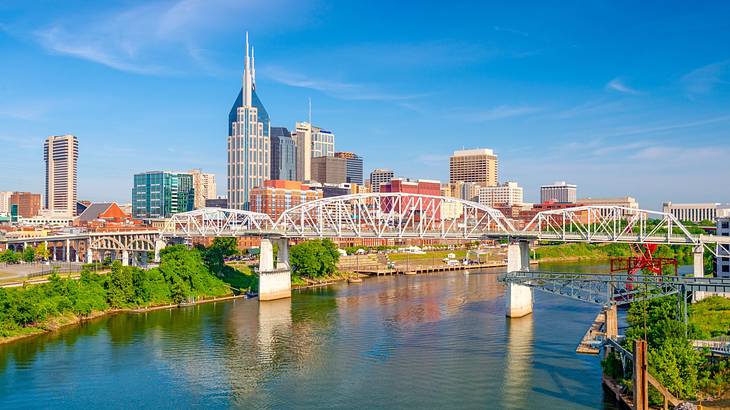

Nashville is a vibrant city in Tennessee, in the Southern United States. The area is known for its country music influence, rich history, and incredible food.
When visiting Nashville, you'll find a host of things to do. Being such a culturally and historically significant place, you'll also discover a range of famous landmarks in Nashville, Tennessee.
These Nashville landmarks range from country music-related spots, like the Country Music Hall of Fame, to sites of historical importance, such as the former home of Andrew Jackson. If you intend to visit this Tennessee city, continue reading to discover which famous places in Nashville you can't miss!
Planning a last-minute trip to Nashville?
When visiting Nashville, book your entrance tickets and tours before you go. We've pulled together top suggestions below.
☂️ Top tours and experiences in Nashville
- Downtown Nashville Public Party Tractor 21 Only (likely to sell out)
- Grand Ole Opry Show Admission Ticket (likely to sell out)
- Nashville Hop on Hop Off Trolley Tour (very popular)
- Best of Nashville City Sightseeing Tour on Double Decker Bus (very popular)
- Nashville Riverboats Sightseeing Cruise
17 Famous Nashville Landmarks
- The Parthenon
- John Seigenthaler Pedestrian Bridge
- Tennessee State Museum
- Hatch Show Print
- Belmont Mansion
- Downtown Presbyterian Church
- Schermerhorn Symphony Center
- Bridgestone Arena
- Andrew Jackson's Hermitage
- Music City Walk of Fame Park
- Tennessee State Capitol
- Grand Ole Opry House
- Ryman Auditorium
- Bicentennial Capitol Mall State Park
- Cheekwood Estate & Gardens
- Country Music Hall of Fame and Museum
- The Johnny Cash Museum
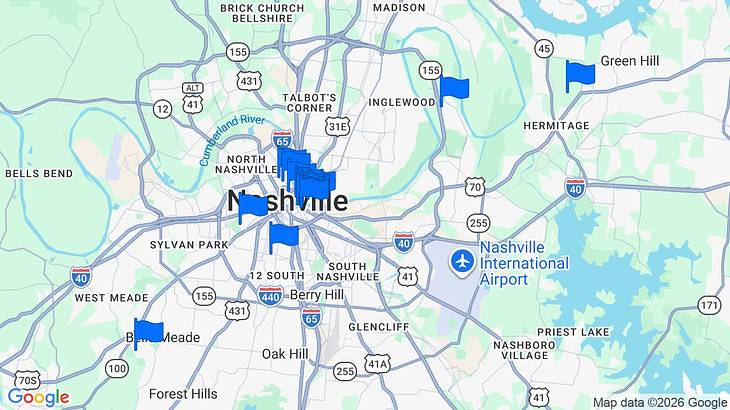
Nashville Landmarks Map
A map of Nashville landmarks. Use the map to explore all of the points of interest.

The Parthenon
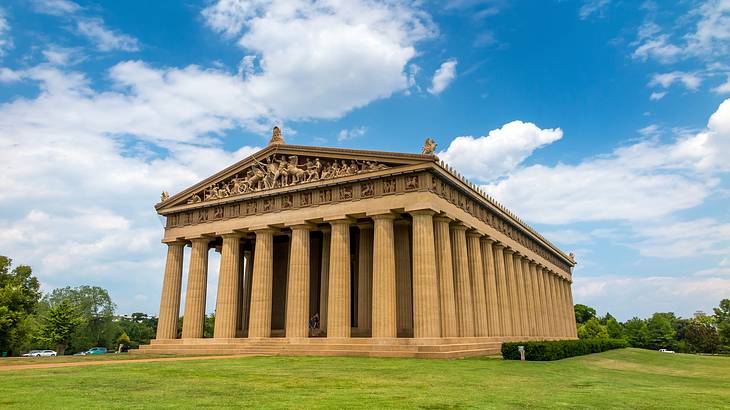
Built for Tennessee's 1897 Centennial Exposition, the Nashville Parthenon in Centennial Park is the world's only full-scale replica of the ancient Greek temple in Athens. Originally made of plaster and wood, the structure was rebuilt in concrete during the 1920s.
Inside, a 42-foot gilded statue of Athena by sculptor Alan LeQuire dominates the main hall. Completed in 1990 and covered in gold leaf in 2002, it ranks as the largest indoor sculpture in the Western world. Plaster casts of the original Parthenon Marbles can be found in the Treasury Room.
The museum's permanent collection, donated by James M. Cowan, features 63 paintings by 19th- and 20th-century American artists. Temporary exhibits rotate through additional galleries throughout the year.
☂️ Visit The Parthenon with an excursion
John Seigenthaler Pedestrian Bridge
Stretching 3,150 feet across the Cumberland River, the John Seigenthaler Pedestrian Bridge is one of the longest pedestrian bridges in the world. The truss bridge originally opened in 1909 as the Shelby Street Bridge, carrying vehicle traffic between downtown and East Nashville.
After being closed to cars in 1998, the bridge was renovated and reopened to pedestrians and cyclists in 2003. It was renamed in 2014 to honor journalist and civil rights advocate John Seigenthaler. The structure has been listed on the National Register of Historic Places since 1998.
Walking the full length takes about 10 to 15 minutes and rewards you with sweeping views of the Nashville skyline and the riverfront. Sunset is a particularly good time to cross, as the downtown buildings catch the light.

Tennessee State Museum
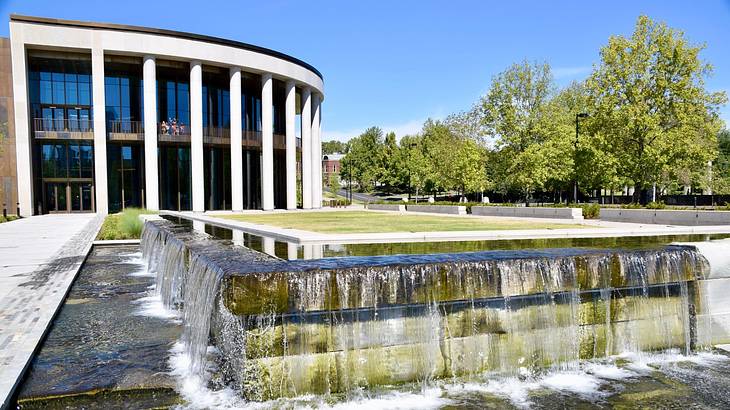
Free to enter, the Tennessee State Museum traces the state's history from its earliest inhabitants through the present day. The 137,000-square-foot building, which opened at its current location in 2018, features a "Tennessee Time Tunnel" of permanent exhibits covering Native American heritage, military history, and the Civil War.
The museum's Civil War collection of uniforms, battle flags, and weapons ranks among the most significant of its kind in the country. Other displays include art, furniture, textiles, and photographs produced by Tennesseans across centuries.
A hands-on children's gallery designed for ages three through eight makes this a good activity for families. Several rotating galleries host temporary exhibits on topics ranging from cultural history to the arts.
☂️ Visit Tennessee State Museum on a tour
Hatch Show Print
Founded in 1879 by brothers Charles and Herbert Hatch, this letterpress poster shop is one of the oldest working print shops in America. For much of the 20th century, Hatch Show Print produced posters for Grand Ole Opry stars like Bill Monroe and Minnie Pearl, as well as Elvis Presley and Chuck Berry.
In 1992, the shop became a property of the Country Music Hall of Fame and Museum. It is now located inside the museum complex in downtown Nashville, where it still designs and prints hundreds of posters each year using hand-carved woodblocks and vintage presses.
Guided tours let you watch the printing process up close and browse collectible merchandise. The shop's bold, tactile poster designs have become iconic symbols of Nashville's entertainment heritage.
☂️ Visit Hatch Show Print on a tour
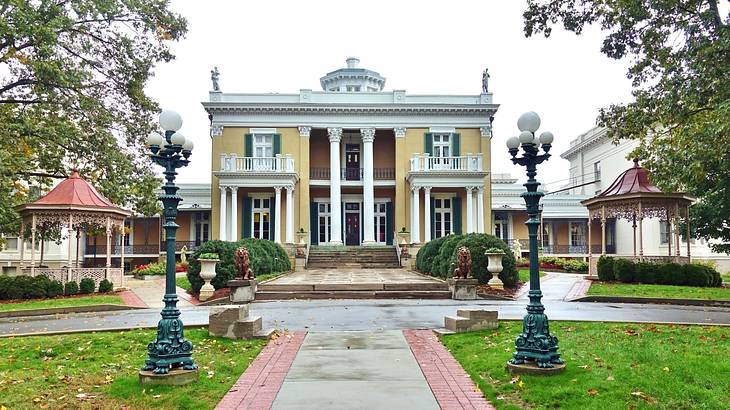

Belmont Mansion
Adelicia Acklen, one of the wealthiest women in antebellum America, built this Italianate villa between 1849 and 1853. The 36-room estate originally sat on roughly 175 acres and featured an art gallery, bowling alley, and a conservatory. Today, the Belmont Mansion is the largest house museum in Tennessee.
Guided tours walk you through restored rooms furnished with period pieces, marble statuary, and original Venetian glass. The tours also cover the lives of the enslaved people who lived and worked on the property.
During the Civil War, Union General Thomas J. Wood occupied the mansion before the Battle of Nashville in December 1864. The grounds sustained damage, but the house and its contents survived intact.
☂️ Visit Belmont Mansion with a tour
Downtown Presbyterian Church
One of the finest surviving examples of Egyptian Revival church architecture in the United States, the Downtown Presbyterian Church has stood at Fifth Avenue and Church Street since 1851. Architect William Strickland gave the building lotus-topped columns and a winged sun disk on its facade.
The congregation dates to 1814, making it Nashville's first organized Christian church. Presidents Andrew Jackson and James K. Polk both worshipped here, and Polk was inaugurated as governor of Tennessee in the second building in 1839.
Designated a National Historic Landmark in 1993, the church is still active and open to the public. During the Civil War, Union forces used the building as a hospital.
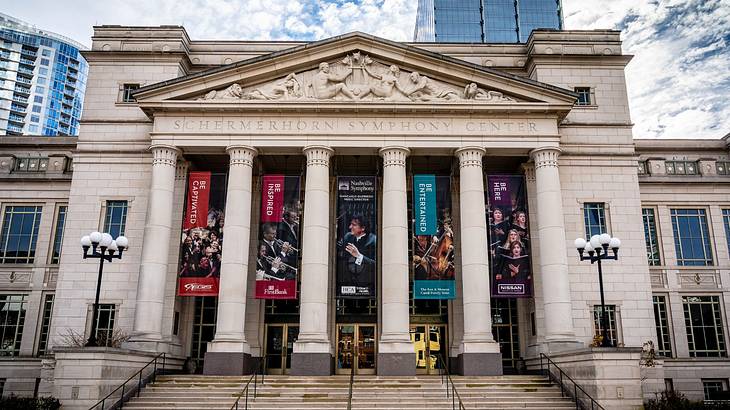

Schermerhorn Symphony Center
Opened in September 2006, Schermerhorn Symphony Center is the home of the Nashville Symphony and is named after the late Maestro Kenneth Schermerhorn, who led the orchestra for 22 years. The neoclassical building houses the 1,844-seat Laura Turner Concert Hall, one of the few in the country to feature natural light through 30 soundproof windows.
The Nashville Symphony performs a wide range of programming here, from classical and pops concerts to jazz and more. Catching a performance is one of the most romantic date ideas in Nashville.
A public garden enclosed by a colonnade faces Hall of Fame Park. It is a pleasant spot to take a break during a day of sightseeing downtown.
☂️ Visit Nashville Symphony Schermerhorn Symphony Center with an experience
Bridgestone Arena
Completed in December 1996, Bridgestone Arena is a multi-purpose venue on Broadway in downtown Nashville. Originally called Nashville Arena, the building was renamed after Bridgestone Americas secured the naming rights in 2010. Its design by Populous was angled to echo the shape of the nearby Ryman Auditorium.
The arena is home to the Nashville Predators, the city's NHL franchise, which has played here since 1998. Seating for hockey holds over 17,000, and configurations for other events can accommodate up to 20,000.
Beyond game nights and concerts, the arena has hosted the CMA Awards, the SEC Basketball Tournament, and multiple nationally televised events. Its location on Broadway puts you steps from Nashville's honky-tonk district.
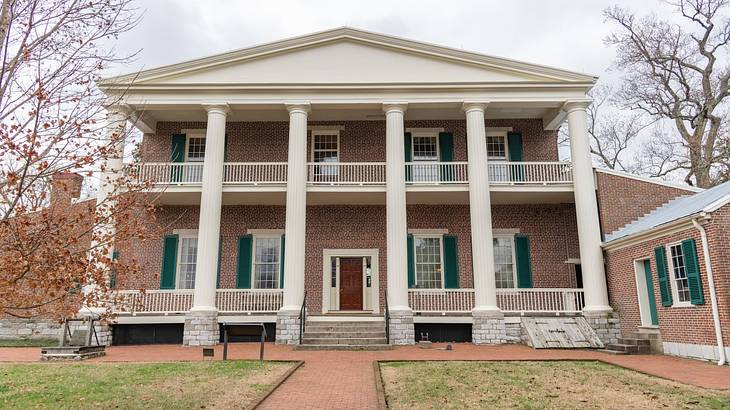

Andrew Jackson's Hermitage
Spread across 1,120 acres east of downtown Nashville, Andrew Jackson's Hermitage is among the most accurately preserved presidential homes in the country. The seventh president purchased the property in 1804 and died here on June 8, 1845.
The Greek Revival mansion, rebuilt in 1837, anchors a site with more than 30 historic buildings. These include restored cabins where enslaved people lived, a church built for Jackson's wife Rachel, and a formal garden where both Jacksons are buried.
Interpreter-led mansion tours run throughout the day, and a self-guided audio tour covers the wider grounds. A winery and tasting room on the property offer a chance to unwind after exploring.
Music City Walk of Fame Park
Honoring artists, songwriters, and music industry figures who shaped Nashville's identity, the Music City Walk of Fame features stainless steel and terrazzo stars embedded in the sidewalk. Established in 2006, the walk sits in a public park between the Country Music Hall of Fame, Bridgestone Arena, and Schermerhorn Symphony Center.
Inductees span genres and generations. You will find names like Elvis Presley, Dolly Parton, Jimi Hendrix, Kenny Rogers, and Kings of Leon among the honorees. New stars are added twice a year during public induction ceremonies.
The walk is free, compact, and easy to combine with nearby attractions. Strolling the full path takes only a few minutes, making it a worthwhile stop between longer visits to the surrounding Tennessee landmarks.


Tennessee State Capitol
Construction of the Tennessee State Capitol began on July 4, 1845, and took 14 years to complete. Architect William Strickland designed the Greek Revival building from Tennessee limestone in the Ionic order, and he considered it his finest work. The Capitol sits atop Cedar Knob, the highest point in downtown Nashville.
Strickland died in 1854 before the project was finished. At his request, he was buried within the northeast wall of the building. The grounds also hold the tombs of President James K. Polk and his wife Sarah, along with statues of Andrew Jackson, Andrew Johnson, and Civil War hero Sam Davis.
Free guided tours, led by Tennessee State Museum staff, take you through the legislative chambers and the governor's office. The interior cast-iron spiral staircase and library balconies are worth seeing up close.
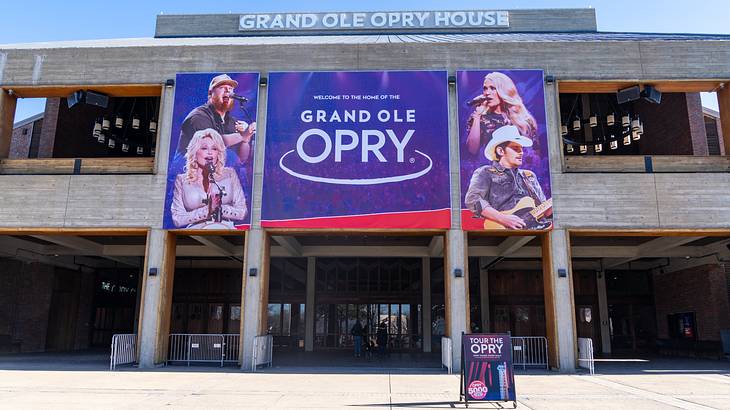

Grand Ole Opry House
The Grand Ole Opry radio show has been on the air since 1925, making it the longest-running live radio broadcast in American history. The show moved into its first purpose-built home when the Grand Ole Opry House opened on March 16, 1974. The 4,400-seat venue was added to the National Register of Historic Places in 2015.
A six-foot oak circle from the Ryman Auditorium stage sits at the center of the Opry House stage, connecting the venue to its predecessor. The building recovered from severe flood damage in 2010 and reopened that September.
Live shows run multiple nights a week, featuring both legendary and emerging country acts on the famous Tennessee stage. Backstage tours offer a behind-the-scenes look at the dressing rooms and the Artist Entrance.
☂️ Explore Grand Ole Opry with a tour
Ryman Auditorium
Steamboat captain Thomas Ryman commissioned the Union Gospel Tabernacle in 1885, and the building opened in 1892. It served as the home of the Grand Ole Opry from 1943 to 1974, which helped contribute to Nashville's reputation as the "Music City." The auditorium seats 2,362 across its original wooden church pews.
After the Opry moved out, the Ryman sat mostly unused until a major renovation in 1994 brought it back to life as a premier concert venue. It was designated a National Historic Landmark in 2001 and named a Rock and Roll Hall of Fame Landmark in 2022.
Today, the Ryman hosts performers across every genre, from country and bluegrass to rock and comedy. Self-guided and backstage tours are available during the day.
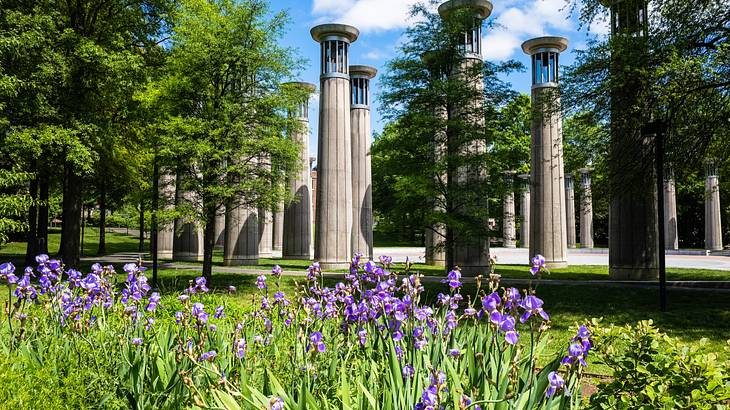

Bicentennial Capitol Mall State Park
Dedicated on June 1, 1996, Tennessee's 200th birthday, this 19-acre urban park sits just north of the State Capitol. Modeled after the National Mall in Washington, DC, the park was designed to celebrate the state's history, geography, and culture through a series of monuments and educational features.
Key attractions include a 200-foot granite map of Tennessee's 95 counties, a 95-bell carillon, and the Pathway of History, a wall engraved with major events from 1796 to 1996. A World War II memorial honors the state residents who lost their lives in the conflict.
The park is flat, paved, and free to explore year-round. It pairs well with a visit to the adjacent Tennessee State Capitol and the Nashville Farmers' Market, which is just across the street.
☂️ See Bicentennial Capitol Mall State Park on a tour
- Downtown Nashville's Hidden Gems E-bike Tour (frequently earns a five-star rating)
- Taste of Nashville Food & Sightseeing Tour (extremely popular)
Cheekwood Estate & Gardens
This 55-acre estate southwest of downtown Nashville was built in the 1930s with proceeds from the Maxwell House Coffee fortune. The Cheek family's Georgian-style mansion and surrounding grounds were gifted to the public and opened in 1960 as a botanical garden and art museum.
The estate was listed on the National Register of Historic Places in 2000. Thirteen distinct gardens cover the grounds, including a Japanese tea garden, a color garden, and a wildflower garden. A mile-long woodland sculpture trail winds through 14 acres of forest, displaying large-scale contemporary works along the way.
Inside the mansion, galleries house a permanent collection of American art spanning the 18th to mid-20th centuries. Seasonal events throughout the year draw visitors for everything from holiday light displays to outdoor concerts.
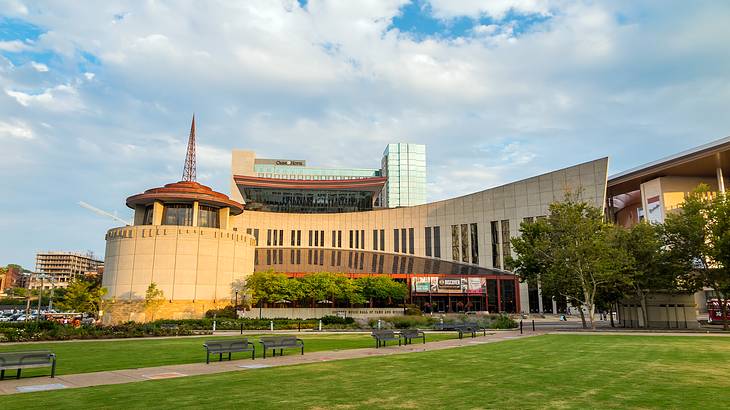

Country Music Hall of Fame and Museum
The Country Music Hall of Fame and Museum holds a collection of more than 2.5 million artifacts, including recordings, instruments, costumes, photographs, and films. First opened on Music Row in 1967, the museum moved to its current 350,000-square-foot downtown location in 2001 and expanded again in 2014.
Permanent exhibits trace the genre's evolution from its folk roots to the present day. You can see everything from Hank Williams' Martin guitar to stage outfits worn by Dolly Parton and Kacey Musgraves.
The museum also operates Historic RCA Studio B, the oldest surviving recording studio in Nashville, where artists like Elvis Presley and the Everly Brothers recorded. Tours of the studio depart daily from the museum and include transportation to Music Row.
The Johnny Cash Museum
Opened in 2013 and officially authorized by the Cash estate, the Johnny Cash Museum holds the world's largest collection of memorabilia dedicated to the Man in Black.
Exhibits are arranged chronologically, covering Cash's childhood in Arkansas, his Air Force service, and his decades-long music career. You will find stage costumes, handwritten lyrics, gold and platinum records, and rare video footage among the displays.
One striking piece is a stone wall salvaged from the Cash family's lake house in nearby Hendersonville. The museum has been named the top music museum in the world by both Forbes and National Geographic Traveler.
☂️ Explore Johnny Cash Museum with a tour
In Conclusion
From the full-scale Parthenon in Centennial Park to the oak circle on the Grand Ole Opry stage, Nashville's landmarks span centuries of architecture, music, and political history. Whether you spend a day in the downtown core or venture out to the Hermitage, each site adds a distinct layer to the story of the Music City.

Want to keep exploring?
Subscribe for our latest guides.
Thank you for subscribing
We will be in touch soon with our latest guides.
Want to keep exploring?
Subscribe for our latest guides.
Thank you for subscribing
We will be in touch soon with our latest guides.