
Tennessee Nicknames | The Volunteer State

Destguides may receive commissions from purchases made through affiliate links in this article.


The southern state of Tennessee borders the Mississippi River to the west and the Blue Ridge Mountains to the east. It's also part of Appalachia—a geographical and cultural region in the Southeastern United States known for its myths, music, and cuisine.
Tennessee additionally goes by various nicknames that highlight the state's natural beauty, rich history, and cultural contributions. While some of these nicknames are widely recognized, the stories behind them might surprise you.
For example, did you know that the official state nickname, the "Volunteer State," is rooted in Tennessee's military history? Continue reading to learn more about the origins of this and other nicknames with this fun guide!
7 Nicknames for Tennessee


The Big Bend State
The "Big Bend State" nickname dates back to early Cherokee settlements along the Tennessee River. The name "Tennessee" is believed to have originated from a Cherokee village named Tanasi (also spelled Tanasse or Tannassy), which early European settlers interpreted to mean "bend in the river."
The nickname also reflects the region's geography. The Tennessee River originates in Knoxville and is the largest tributary of the Ohio River, stretching 652 miles. This natural landmark flows through Tennessee twice, briefly passing through neighboring states like Alabama before curving back into Tennessee—creating the "big bend" for which the state is nicknamed.
The Butternut State
The "Butternut State" nickname is a nod to Tennessee's Civil War history. During the war, many Tennessee soldiers wore uniforms dyed a light brown using butternut dye, made from the bark and husks of the butternut tree. The dye was affordable and readily available, making it a practical choice at the time.
Also known as white walnut, the butternut tree is native to Tennessee, so the nickname reflects the state's natural flora as well.


The Hog and Hominy State
The "Hog and Hominy State" is a nickname that has largely fallen out of use. It gained popularity in the mid-1800s, when Tennessee experienced a boom in corn and pork production. The moniker was a fitting tribute to the strength of the state's agricultural economy at the time.
Interestingly, products such as corn, soybeans, and others are still some of Tennessee's most commonly-grown crops. However, the state has shifted from pork to beef production over the years, making the "Hog and Hominy State" nickname no longer a good fit.
The Mother of Southwestern Statesmen
The "Mother of Southwestern Statesmen" is a nickname that highlights Tennessee's significant role in shaping American government. It's a fitting tribute to a state that produced three U.S. presidents and numerous influential political figures.
Andrew Jackson, the seventh president of the United States, was also Tennessee's first representative in Congress. James K. Polk, the eleventh president, previously served as the ninth Governor of Tennessee.
In 1865, Andrew Johnson—formerly the state's fifteenth governor—became the seventeenth president of the United States following the assassination of Abraham Lincoln. Interestingly, Johnson is the only president in U.S. history to return to the Senate after leaving the White House.


The Iris State
The "Iris State" is another nickname for Tennessee that reflects the region's native landscape. Many species of iris—a perennial flower with tall stems and showy, colorful petals—grow throughout the state. The purple iris has even been featured on one of Tennessee's license plates.
In 1933, the iris was officially designated as the state flower. However, this sparked a controversy: several years earlier, a group of elementary school students had successfully campaigned for the passion flower to be recognized as a state symbol.
To resolve the debate, the Tennessee legislature reached a formal compromise in 1973. The passion flower was named the official state wildflower, while the iris became the state's official cultivated flower. Today, the iris remains one of Tennessee's most recognizable and beloved symbols.
The Music City State
The "Music City State" nickname highlights Tennessee's pivotal role in the American music scene. The state capital and largest city, Nashville, is famously known as "Music City" for its deep influence on country, blues, rock and roll, and gospel music.
One of the most iconic landmarks, the Grand Ole Opry, helped establish Nashville as the center of the country music recording industry in the 20th century. Legendary artists like Elvis Presley, Dolly Parton, and Johnny Cash all launched their careers in Tennessee, with many getting their start in Nashville.
Other cities, especially Memphis, also hold an important place in music history. Memphis is the birthplace of rock and roll and home to blues legends like B.B. King. With such a rich musical heritage across the state, it's no surprise that Tennessee earned the nickname the "Music City State."

The Volunteer State
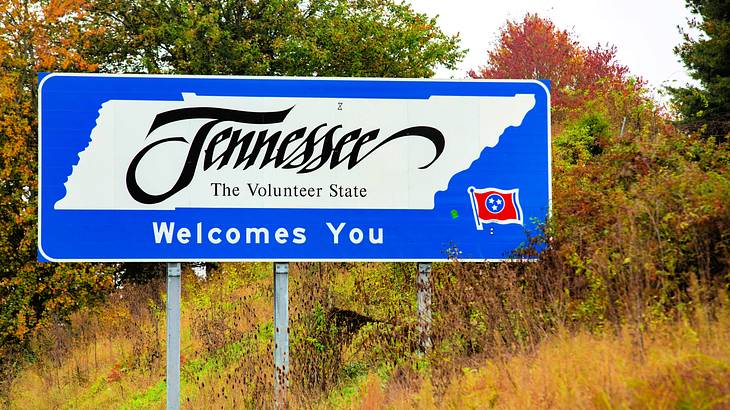
The "Volunteer State" is the official state nickname and arguably the most recognizable of Tennessee's nicknames. Its origin dates back to the War of 1812, when thousands of Tennesseans volunteered to fight the British in the Battle of New Orleans. Their contributions were widely credited with helping secure a decisive American victory.
This volunteer spirit was reinforced during the Mexican-American War, when the state requested 2,600 troops, and more than 30,000 Tennesseans responded.
Today, the legacy lives on through the University of Tennessee, whose student body and athletic teams proudly bear the name "Volunteers." The nickname also appears on the state's license plates, serving as a fitting tribute to Tennessee's history of service and patriotism.
In Summary
Tennessee's nicknames reflect its rich traditions, deep history, and diverse geography. The "Volunteer State" honors the thousands of soldiers who have served the nation, while the "Mother of Southwestern Statesmen" highlights Tennessee's political legacy.
The state's beautiful landscapes also inspired the nickname the "Iris State," and the "Music City State" celebrates its world-famous musical contributions. There are even some nicknames historians feel should remain in the record books. No matter how you view the state of Tennessee, you'll find a nickname that captures its spirit!

Want to keep exploring?
Subscribe for our latest guides.
Thank you for subscribing
We will be in touch soon with our latest guides.
Want to keep exploring?
Subscribe for our latest guides.
Thank you for subscribing
We will be in touch soon with our latest guides.