
38 Famous Landmarks in Spain to Visit

Destguides may receive commissions from purchases made through affiliate links in this article.
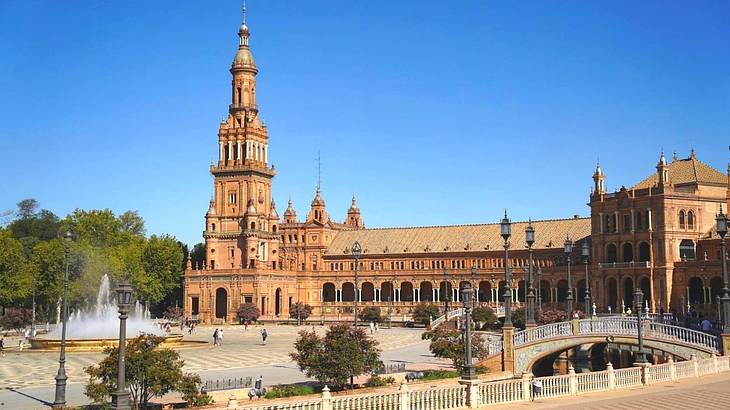
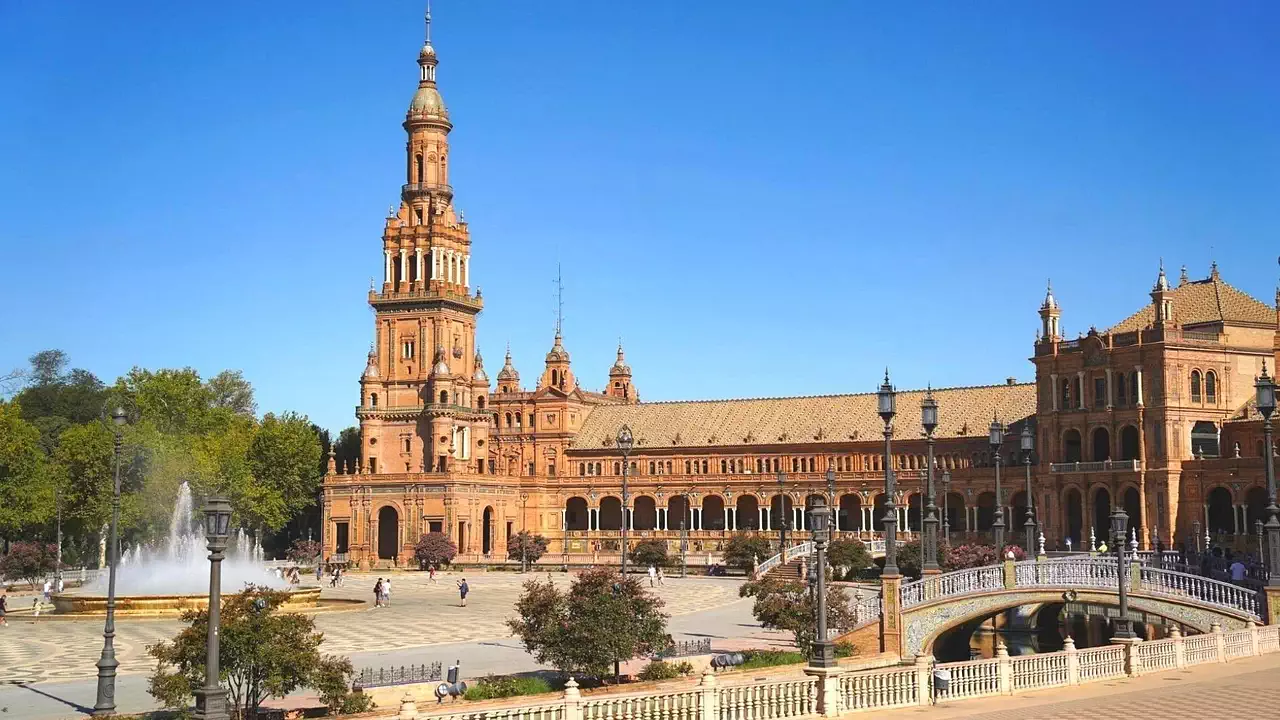
Spain set a tourism record in 2025, welcoming nearly 97 million international visitors, according to its National Statistics Institute. Much of that draw comes from the country's architecture, which spans thousands of years.
Roman amphitheaters, Moorish palaces, Gothic cathedrals, and modernist masterpieces by Antoni Gaudí all share the same landscape. Spain also has 50 UNESCO World Heritage Sites, ranking in the top five countries worldwide.
This article covers 38 famous landmarks in Spain, including ancient fortresses, world-class museums, iconic stadiums, and natural wonders across the Spanish mainland and its islands. Read on to discover the landmarks that draw millions of visitors to Spain every year.
Planning a last-minute trip to Spain?
To make the most of your visit to Spain, we recommend you book entrance tickets and tours soon. Here are some top choices to make your trip enjoyable.
☂️ Top tours and experiences in Spain
- Barcelona - Sagrada Familia Skip-the-Line Guided Tour & Tickets (likely to sell out)
- Tenerife - Loro Parque Entry Ticket (likely to sell out)
- Siam Park Entry Tickets (likely to sell out)
- Barcelona - Casa Batlló Entry With Self-Audioguide Tour
- Sagrada Familia Fast Track Guided Tour With Towers Access
38 Famous Spanish Landmarks
- Ciudad de las Artes y las Ciencias
- Museo Picasso Málaga
- Spotify Camp Nou
- Templo del Sagrado Corazón de Jesús
- La Pedrera - Casa Milà
- La Sagrada Familia
- Font Màgica de Montjuïc
- Parc de la Ciutadella
- Palau de la Música Catalana
- Park Güell
- Parc d'Atraccions Tibidabo
- Palau Güell
- Casa Batlló
- San Lorenzo de El Escorial
- Museo Nacional Centro de Arte Reina Sofía
- Palacio Real de Madrid
- Museo Nacional del Prado
- Plaza Mayor
- Plaza de Toros de Las Ventas
- Templo de Debod
- Estación de Atocha
- Alcázar de Segovia
- Mezquita-Catedral de Córdoba
- Catedral de Santiago de Compostela
- El Teide
- Alhambra
- Castell de Bellver
- Cuevas del Drach
- Catedral de Sevilla
- Plaza de España
- Museo Guggenheim Bilbao
- Muralla de Ávila
- Torre de Hércules
- Castillo de Colomares
- Catedral de Burgos
- Santa Maria de Montserrat
- Casas Colgadas
- Alcázar de Toledo
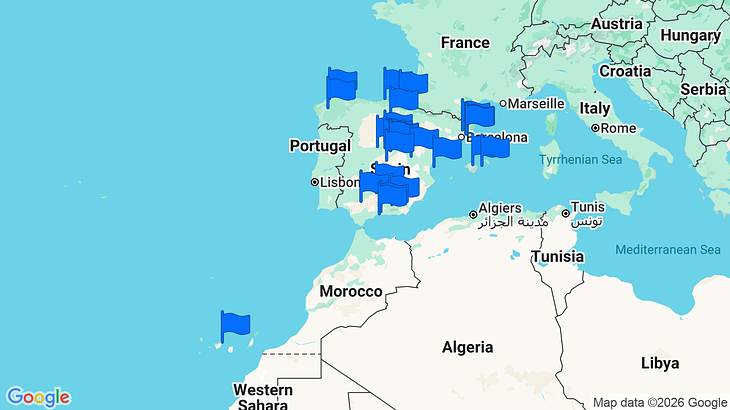
Spain Landmarks Map
A map of Spain landmarks. Use the map to explore all of the points of interest.
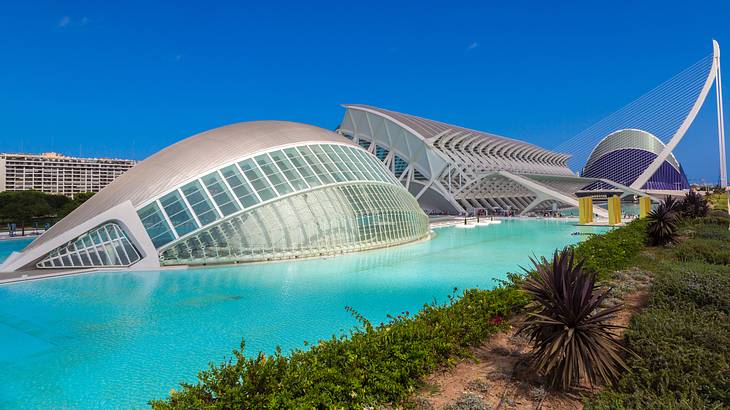

Ciudad de las Artes y las Ciencias
The Turia River once ran through this ground until a 1957 flood pushed Valencia to divert it. The drained riverbed became parkland, and this complex now stretches nearly two kilometers along it.
Santiago Calatrava and Felix Candela designed The City of Arts and Sciences, with construction running from 1996 to 2009. Six structures make up the site.
L'Hemisferic combines a planetarium and an IMAX cinema, and L'Oceanografic, designed by Candela, is Europe's largest aquarium. The others are the Museu de les Ciencies Principe Felipe, the Palau de les Arts Reina Sofia opera house, the L'Umbracle promenade, and the El Agora pavilion.
☂️ Visit the Ciudad de las Artes y las Ciencias with a tour
- Private TukTuk Tour Two Hours of Valencia (highly rated)
- Valencia - Tuk tuk Tour
Museo Picasso Málaga
Pablo Picasso was born in Malaga in 1881, though the city waited more than a century to open a museum in his name. It did so on the 27th of October, 2003, inside the 16th-century Buenavista Palace in the historic center.
The permanent collection holds 233 works spanning eight decades, including paintings, sculptures, ceramics, drawings, and engravings. His daughter-in-law, Christine, and grandson, Bernard Ruiz-Picasso, donated them.
Eleven rooms trace his development in sequence, from early academic studies through cubism to his late reworkings of the Old Masters.
☂️ See the Picasso Museum in Málaga on a tour
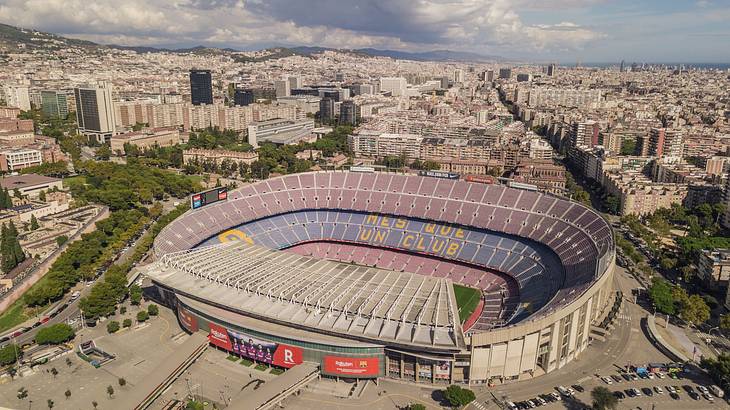

Spotify Camp Nou
FC Barcelona opened this stadium in the Les Corts neighborhood on the 24th of September, 1957. Francesc Mitjans, Josep Soteras, and Lorenzo Garcia-Barbon designed it, working mainly in concrete and iron.
Two European Cup finals were decided on this pitch, in 1989 and 1999. The ground also hosted the 1992 Olympic football final and matches during the 1982 World Cup. The club museum traces Barcelona's history back to its founding in 1899 and holds the trophy collection.
☂️ Visit the Camp Nou Stadium with an excursion
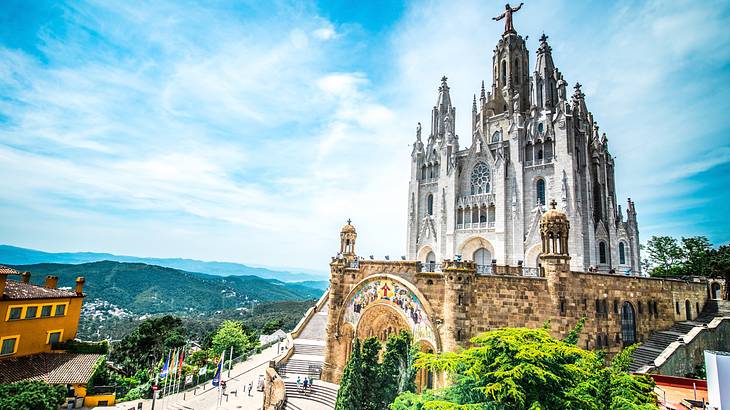

Templo del Sagrado Corazón de Jesús
Mount Tibidabo rises 512 meters above Barcelona, the city's highest point, and the Temple of the Sacred Heart of Jesus crowns it. Catalan architect Enric Sagnier i Villavecchia began work in 1902, and his son Josep Maria Sagnier i Vidal finished it in 1961.
Neo-Byzantine, Neo-Romanesque, and Neo-Gothic elements combine across two levels. A crypt occupies the lower church, while the upper section carries an octagonal dome topped by a bronze statue of Christ. Its position on the ridge makes the building visible from most of Barcelona.
La Pedrera - Casa Milà
Rough limestone gave this building its nickname. La Pedrera means "the quarry," and locals used it as an insult when the facade first appeared on Passeig de Gracia. Antoni Gaudi built it for the Mila family between 1906 and 1912, his last private residential commission.
Not a single straight line appears in the exterior, and UNESCO listed the building in 1984. One floor recreates a middle-class Barcelona home of the early 20th century, and the attic explains Gaudí's structural methods. The sculpted rooftop chimneys are the most photographed part.
☂️ Visit Casa Milà with a tour
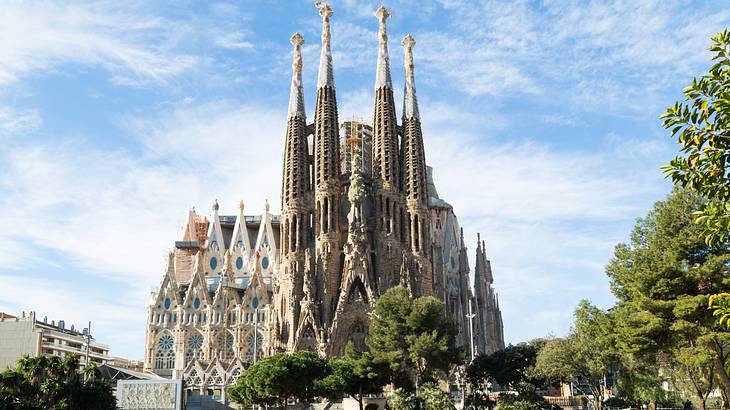

La Sagrada Familia
Work on this basilica began on the 19th of March, 1882, under Francisco de Paula del Villar. Gaudi took over the following year and spent the rest of his life on it. Asked about the slow pace, he replied that his client was not in a hurry.
Gaudi died on the 10th of June, 1926, after being struck by a tram, and is buried in the crypt. Anarchists destroyed most of his models in 1936. Pope Benedict XVI consecrated the church in November 2010, and the Tower of Jesus Christ reached full height in February 2026. Eighteen towers are planned in total.
☂️ Visit the Sagrada Familia with an excursion
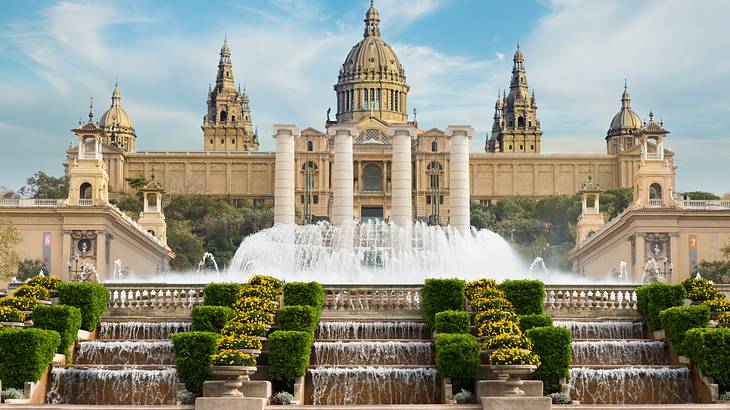
Font Màgica de Montjuïc
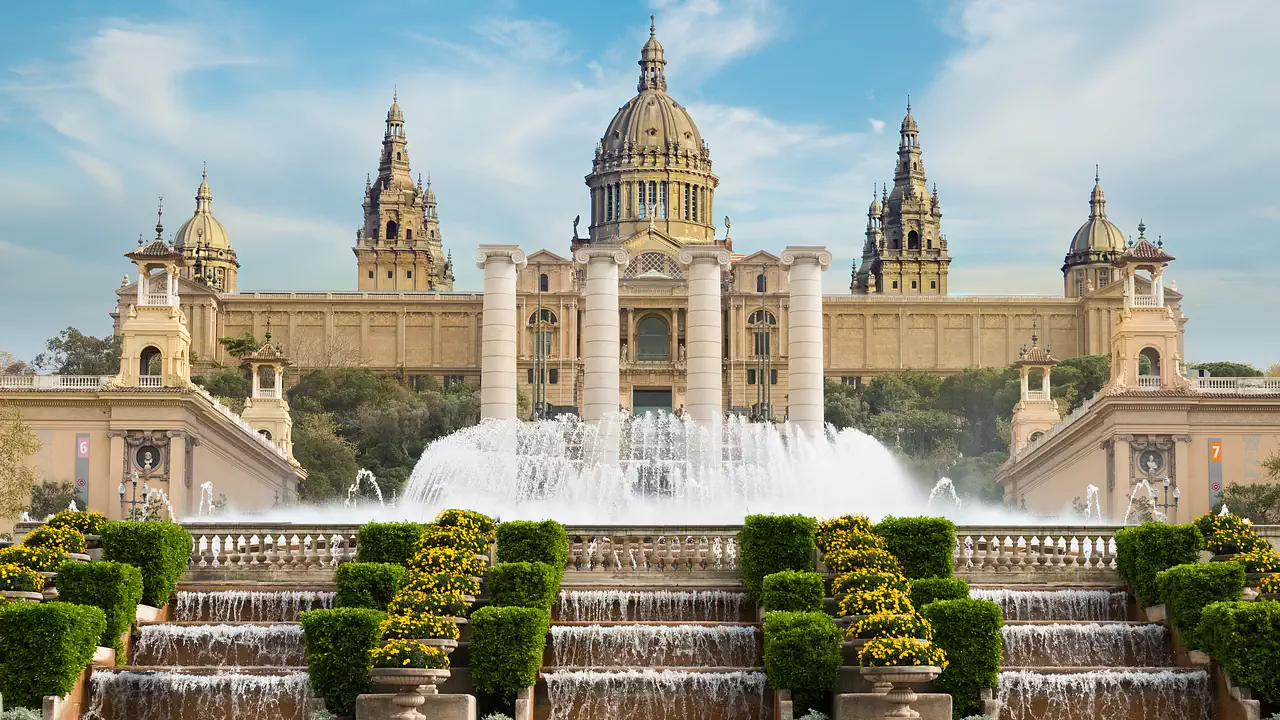
Engineer Carles Buigas built this fountain at the base of Montjuic Hill for the 1929 International Exposition. Water, light, and music combine in choreographed displays that continue to this day.
Montjuic served as a defensive position for centuries before the exposition transformed it. The Palau Nacional stands directly above the fountain and houses the National Art Museum of Catalonia. Evening shows draw large crowds through the warmer months.
☂️ Explore the Magic Fountain of Montjuïc on a tour

Parc de la Ciutadella
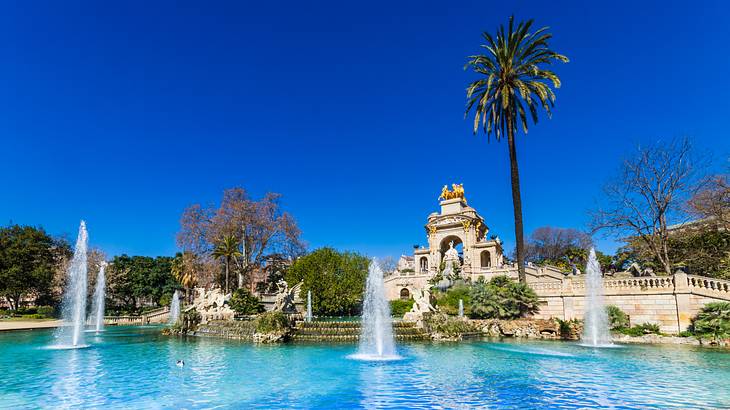
Philip V built a military citadel here after the War of the Spanish Succession, and the people of Barcelona resented it for more than a century. General Prim ordered it demolished in 1869, and architect Josep Fontsere laid out the park that replaced it. The grounds hosted the Universal Exposition of 1888.
The Cascada Monumental anchors the northern end, and a young Gaudí worked on its design while still a student. The park also contains a boating lake, the Barcelona Zoo, and the Catalan Parliament, which now sits on ground once used to garrison troops against the city.
☂️ Join a tour to see Ciutadella Park
- Barcelona - Three-Hour Sagrada Familia EScooter Tour (usually sold out)
- Barcelona - Two-Hour E-Scooter Tour (rated highly)

Palau de la Música Catalana
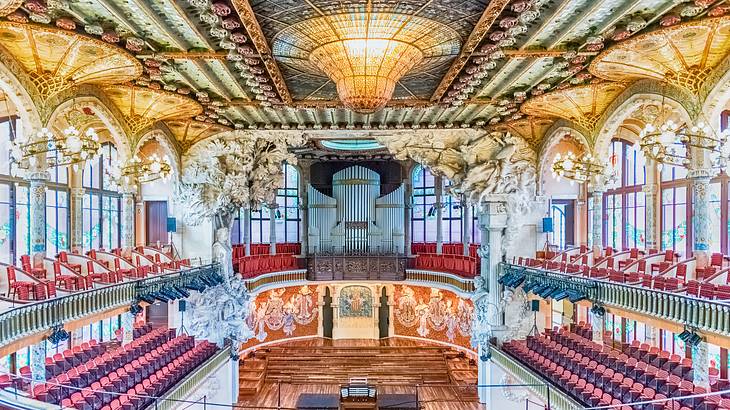
Barcelona's Palau de la Música Catalana was built between 1905 and 1908 as a home for the Orfeo Catala, a choral society founded in 1891 by Lluís Millet and Amadeu Vives. Lluís Domènech i Montaner designed it in the Catalan Modernist style, and UNESCO listed the building in 1997.
Daylight reaches the almost 2,000-seat auditorium through an inverted stained-glass dome by Antoni Rigalt, shaped to represent the sun and hanging into the room like a suspended bowl. Sixteen muses surround the stage, their lower halves worked in flat mosaic and their upper halves in full relief.
☂️ Explore the Palau de la Música Catalana on a tour

Park Güell
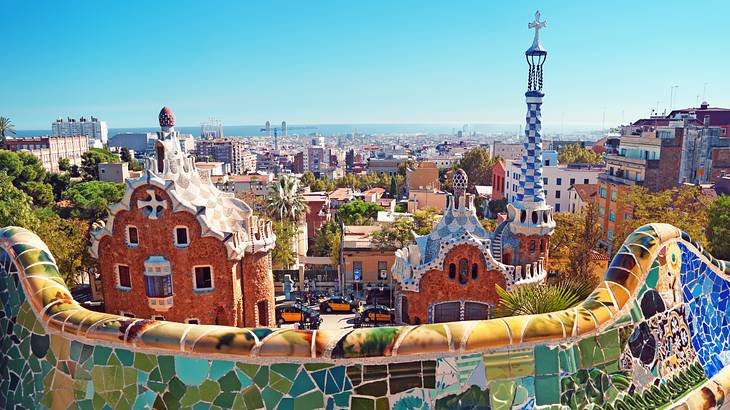
Eusebi Güell wanted a garden city of 60 houses on a bare hillside above Barcelona and hired Gaudí to design it. Work ran from 1900 to 1914, but only two houses ever sold. The city bought the land from Güell's heirs after his death and opened the failed development as Park Güell in 1926.
Its Hypostyle Room rests on 86 hollow columns that channel rainwater into an underground cistern, with the mosaic dragon on the staircase acting as the overflow. Above sits the serpentine bench, largely the work of Josep Maria Jujol.
☂️ Explore Park Güell with a tour
- Barcelona - Park Güell Admission Ticket (often fully booked)
- Park Guell & Sagrada Familia Tour With Skip the Line Tickets (a top tour)
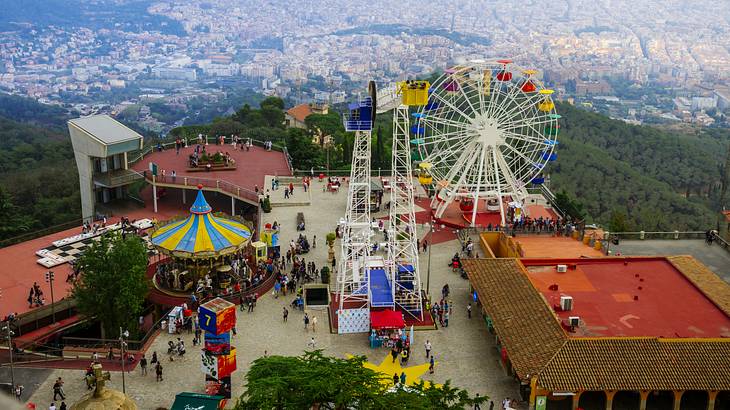

Parc d'Atraccions Tibidabo
Spain's oldest amusement park still in operation shares its ridge with the Sagrat Cor church. Pharmacist and entrepreneur Salvador Andreu bought the land in 1899 and opened Parc d'Atraccions Tibidabo to the public in 1905, making it among the oldest surviving parks.
Several attractions from the park's early decades still run alongside modern rides. Getting there is part of the experience, as a tram and a funicular railway carry visitors up the hill, both built to serve the park and the church above it.
☂️ Explore Parc datraccions Tibidabo on a tour
- Barcelona City Tour Hop-On Hop-Off With Optional Catamaran Trip (popular and sought-after)
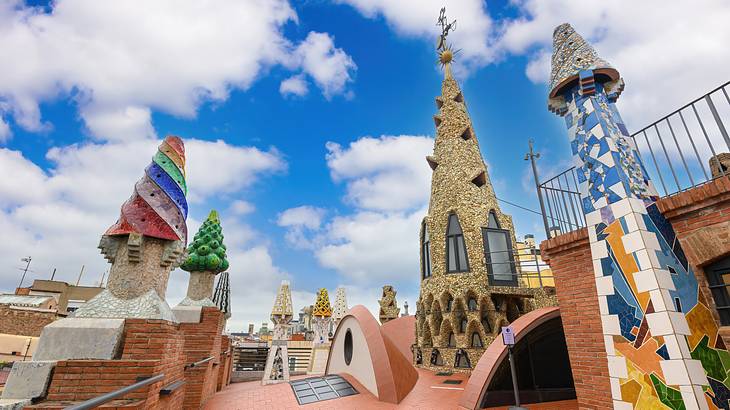

Palau Güell
Eusebi Güell commissioned this mansion from Gaudí in the 1880s. It sits just off the narrow Carrer Nou de la Rambla, a cramped street that left the architect very little room to work with.
Art Nouveau details dominate the stone facade, and the interior turns inward around a tall central hall. Parabolic arches at the entrance let carriages pass straight into the building. On the roof, 20 chimneys and ventilation shafts are covered in broken ceramic mosaic. Palau Güell, along with Park Güell, became a UNESCO World Heritage Site in 1984, like Casa Milà.
☂️ Visit the Güell Palace with a tour
Casa Batlló
Emili Sala Cortés built the original house at Passeig de Gràcia 43 in 1877, and one of his architecture students was Antoni Gaudí. Textile industrialist Josep Batlló i Casanovas bought the building in 1903 and hired Gaudí the following year, initially intending to demolish it. Gaudí talked him out of that, and Casa Batlló is the renovation that followed, carried out between 1904 and 1906.
Gaudí rebuilt the facade in stone and glass, expanded the light well, and reworked the interior layout. The light well is tiled in graded blues so the brighter upper floors sit against darker tile. Scaled roof tiles form an arched ridge, giving the building one of its nicknames, the "House of the Dragon."
☂️ Join a tour to see Casa Batlló
- Barcelona - Casa Batlló Entry With Self-Audioguide Tour (usually sold out)
- Barcelona - Casa Batlló be The First Entry Ticket (rated highly)
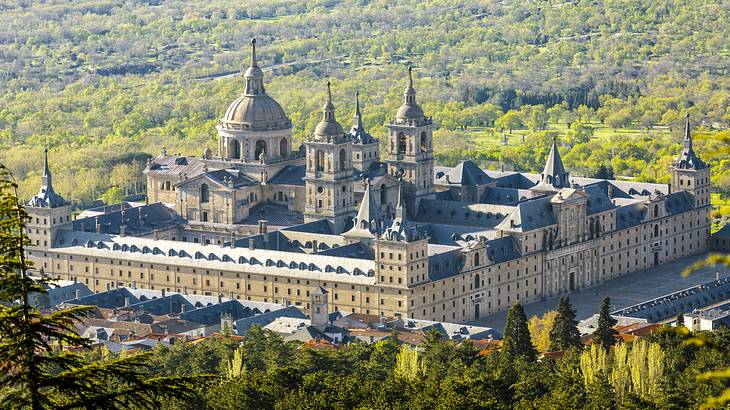

San Lorenzo de El Escorial
A monastery, a basilica, a royal palace, a library, and a pantheon housing the tombs of most Spanish monarchs since Charles V all occupy a single building northwest of Madrid. Philip II ordered the construction of San Lorenzo de El Escorial in the Guadarrama Mountains, and work ran from 1563 to 1584.
Juan Bautista de Toledo began the project, and Juan de Herrera completed it, in a style so influential that it came to be known as Herrera's. The library is the standout, with its barrel-vaulted hall shelving thousands of volumes, the page edges facing outward rather than the spines. It has held World Heritage status since 1984.
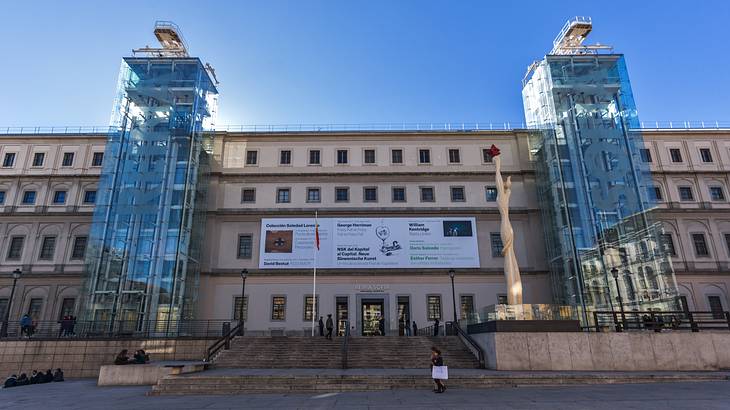

Museo Nacional Centro de Arte Reina Sofía
Picasso painted Guernica in 1937 in response to the bombing of the Basque town of the same name, and it now hangs in the Museo Reina Sofia. The building was an 18th-century hospital designed by José de Hermosilla and Francisco Sabatini, converted for cultural use after it closed in 1968.
The Centro de Arte Reina Sofia gained national museum status by royal decree in 1988, and King Juan Carlos and Queen Sofia inaugurated the permanent collection on the 10th of September, 1992. Jean Nouvel added a wing between 2001 and 2005. Works by Salvador Dali, Joan Miro, and Juan Gris sit alongside the Picasso holdings.
☂️ Visit the Museo Nacional Centro de Arte Reina Sofía on a tour
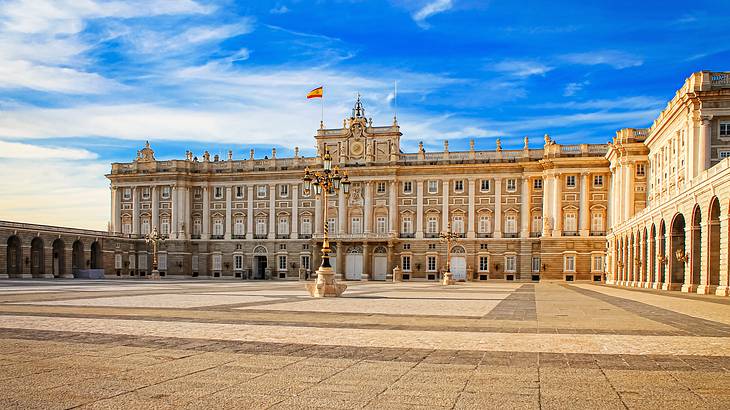

Palacio Real de Madrid
Fire destroyed the old Habsburg fortress on this site on Christmas Eve, 1734, and Philip V ordered a replacement built from stone. Construction ran from 1738 to 1755, following designs by Filippo Juvarra and Giovanni Battista Sacchetti, and Charles III became the first monarch to occupy it in 1764.
With 3,418 rooms across 135,000 square meters, it is the largest royal palace in Western Europe. The Spanish royal family no longer lives here, and the building is used for state ceremonies. Francesco Sabatini designed the main staircase, and the Hall of Columns hosts the most important occasions.
☂️ Visit the Royal Palace of Madrid on a tour
- Madrid - Royal Palace Guided Tour With Skip the Line Ticket (usually sells out)
- Madrid - Royal Palace Skip-the-Line Guided Tour (very popular)
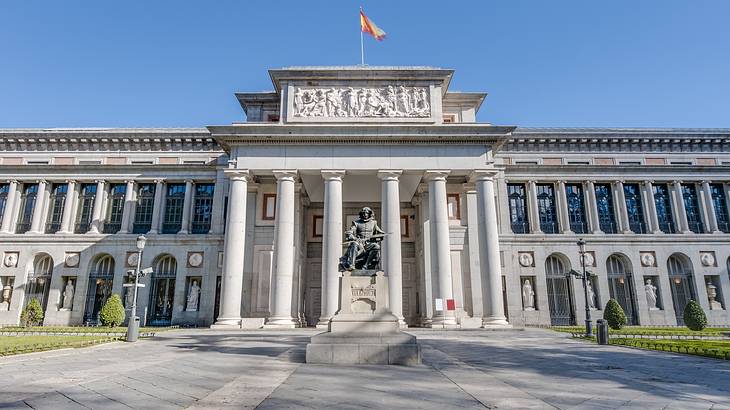

Museo Nacional del Prado
Royal taste shaped this collection more than art history did. The Prado opened in 1819 with a collection built largely by the Habsburg and Bourbon monarchs, which is why it covers some painters exhaustively and others barely at all.
Pieces include those by Velázquez, El Greco, Bosch, Titian, and Rubens. Las Meninas, The Third of May 1808, and The Garden of Earthly Delights also hang here, along with Goya's Black Paintings. Only part of the collection is on display at any one time.
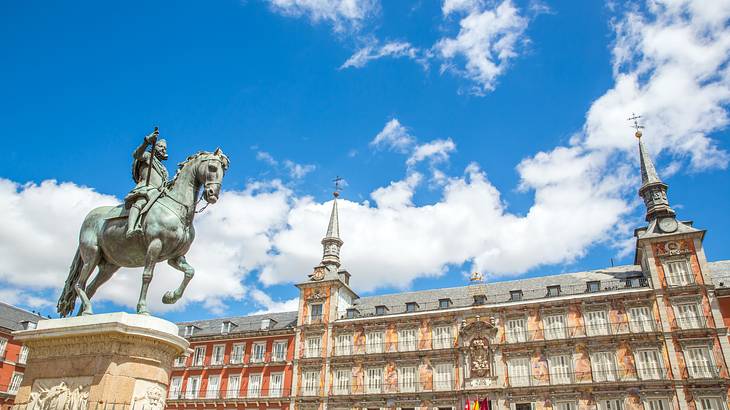

Plaza Mayor
Before it took its current name, this arcaded square was called Plaza del Arrabal and served as the main market outside the city walls. Philip III ordered it rebuilt as a formal square, and Juan Gómez de Mora completed the work in 1619. Fire destroyed much of it three times, and the version standing today dates from a rebuild after 1790.
The square measures roughly 129 meters by 94 meters and is enclosed on all four sides by residential buildings with balconies. Bullfights, executions, and royal proclamations were all staged here. Wandering around Plaza Mayor is a memorable Madrid experience.
☂️ Visit the Plaza Mayor on a tour
- Madrid - One or Two Day Hop-On Hop-Off Sightseeing Bus Tour (likely to sell out)
- Madrid - Skip-the-Line Walking Tour & Royal Palace (frequently earns a five-star rating)
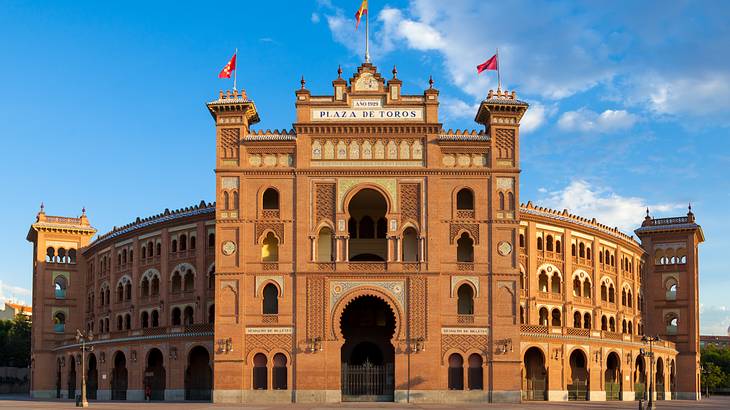

Plaza de Toros de Las Ventas
Madrid's bullring opened on the 17th of June, 1931, in the Salamanca district. José Espelius designed it but died before it was finished, and Manuel Muñoz Monasterio completed the project. The arena measures 60 meters across, making Las Ventas the largest bullring in Spain and the third largest in the world.
Espelius worked in the Neo-Mudejar style, using exposed red brick, horseshoe arches, and ceramic tiles bearing the coats of arms of Spanish provinces. The season runs from March to October, with the San Isidro fair held across May and June. Bullfighting remains contested in Spain, and the building was listed as a cultural monument in 1994.
☂️ Visit the Las Ventas Bullring with a tour
- VIP Visit to the Las Ventas Bullring in Madrid (usually sold out)
- Madrid - Las Ventas Bullring & Museum Tour (a top tour)
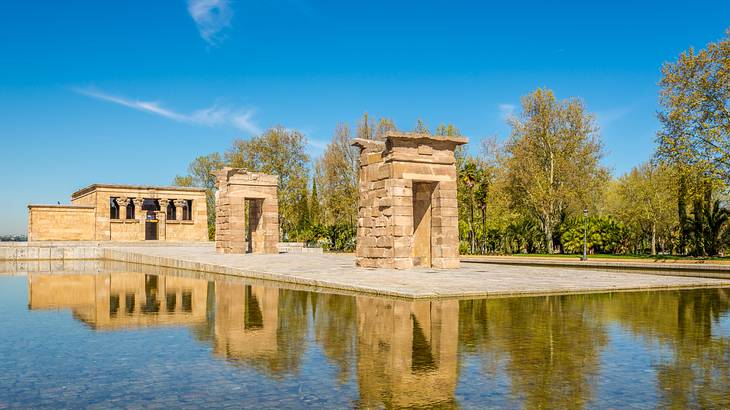

Templo de Debod
Egypt gave this temple to Spain in 1968 in thanks for Spanish help in rescuing monuments threatened by the Aswan High Dam. The structure dates from around the 2nd century BC and originally stood near Aswan, close to the border with Sudan. It was dismantled block by block, shipped west, and rebuilt in Madrid.
Reassembling it accurately took several years, and the temple reopened to the public in 1972. It sits in Parque del Oeste on high ground west of the center, with a reflecting pool laid out in front.
☂️ Discover the Temple of Debod on a tour
- Madrid E-Bike Small Group Tour (frequently sold out)
- Tour Welcome Madrid in Eco Tuk Tuk Private With Local Guide (popular and sought-after)
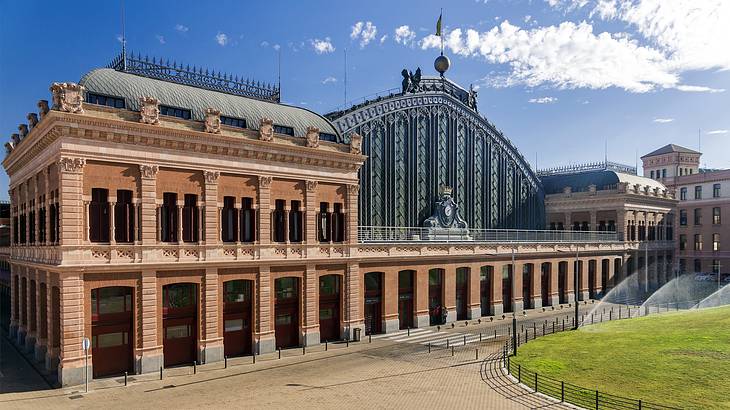

Estación de Atocha
Madrid's first railway station opened on the 9th of February, 1851, under the name Estación de Mediodía, serving the line to Aranjuez. Fire later destroyed much of the structure. Alberto de Palacio Elissagne designed its replacement, working with Gustave Eiffel, and the wrought-iron-and-glass hall was completed in 1892.
Rafael Moneo led the transformation carried out between 1984 and 1992. He moved rail traffic to a new terminal and converted the old hall into a concourse planted as a tropical garden. The 19th-century iron roof still covers it.
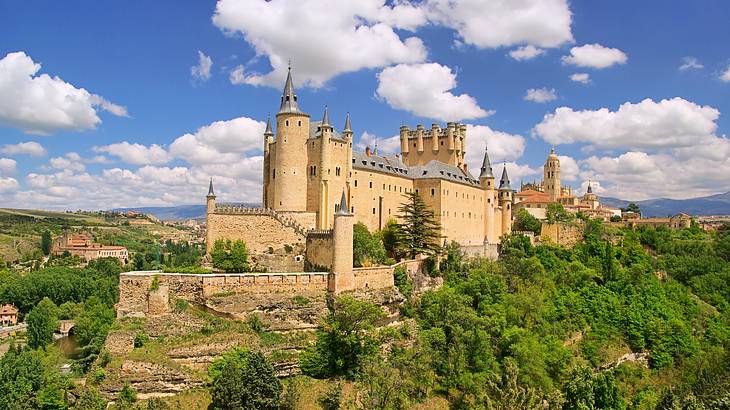

Alcázar de Segovia
Segovia's old town sits on a rocky ridge, and the Alcazar occupies its western tip, above the point where the Eresma and Clamores rivers meet. Records first mention a fortress here in 1120, though the site was fortified in Roman times, and Castilian monarchs expanded it from the 12th century onward.
Isabella I was proclaimed queen at the Alcazar in 1474. It later served as a state prison, and then a Royal Artillery College, and a fire gutted much of the interior in 1862. The building forms part of the Old Town of Segovia and its Aqueduct, inscribed by UNESCO in 1985.
☂️ Visit the Alcázar of Segovia with an experience
- Madrid - Avila & Segovia Day Trip With Tickets to Monuments (high demand)
- From Madrid - Toledo & Segovia Day Tour With Lunch & Tickets (a sort after tour)
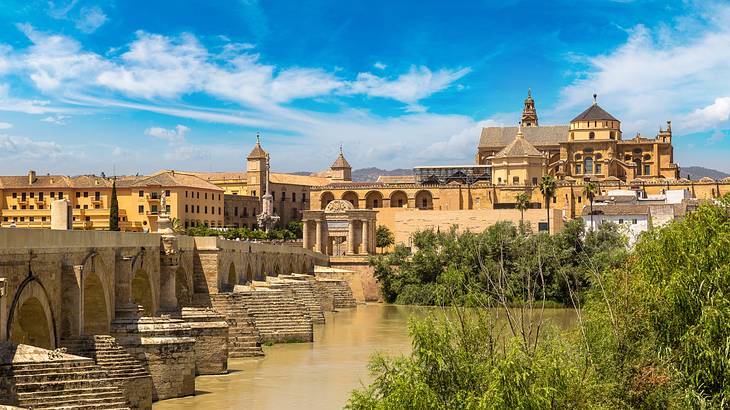

Mezquita-Catedral de Córdoba
Abd al-Rahman I began this building as a mosque in 785, and successive Umayyad rulers expanded it several times. Its prayer hall rests on 856 columns of jasper, marble, and granite, many salvaged from Roman and Visigothic buildings, and carries red-and-white double arches that stretch in every direction.
Ferdinand III took Cordoba in 1236, and the mosque was consecrated as a cathedral. From 1523, a Renaissance nave was inserted into the middle of the prayer hall rather than replacing it, so both buildings now occupy the same walls. The 54-meter bell tower encases the original minaret. It is a must-see when you're in Córdoba, even if you're just in the city for a day.
☂️ Visit the Mosque-Cathedral of Córdoba with an experience

Catedral de Santiago de Compostela
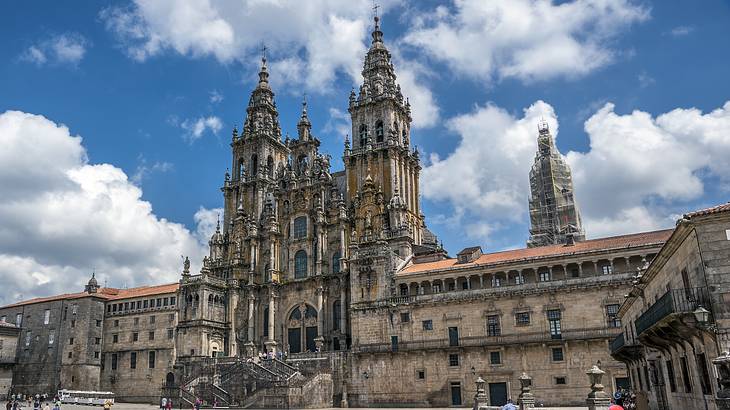
Pilgrims have walked to this cathedral for more than a thousand years to reach what is held to be the tomb of Saint James the Elder. The Camino de Santiago ends at the Praza do Obradoiro in front of it.
Construction began in 1075, and the Romanesque building was consecrated in 1211. The Portico de la Gloria, carved by Master Mateo in the 12th century, stands behind the later Baroque facade added in the 1700s. The cathedral anchors the Santiago de Compostela UNESCO World Heritage Site.
☂️ Join a tour to see the Cathedral of Santiago de Compostela
- Santiago de Compostela - Cathedral & Museum, Optional Pórtico (often fully booked)
- Santiago de Compostela - Old Town Private Tour (rated very highly)

El Teide
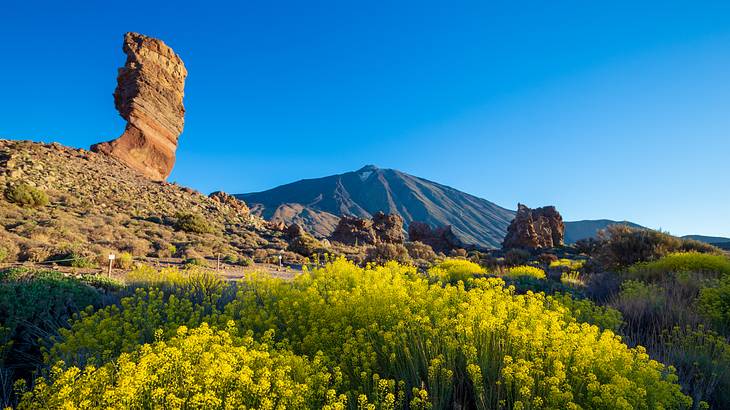
Mount Teide reaches 3,718 meters, making it the highest peak in Spain. Measured from the ocean floor, it rises to 7,500 meters, making it the third-tallest volcanic structure in the world. The national park around it was inscribed by UNESCO in 2007 and covers the Teide-Pico Viejo stratovolcano and the Las Cañadas caldera.
A cable car climbs from the base station to La Rambleta at 3,555 meters in roughly eight minutes. It does not reach the summit. The final stretch of the Telesforo Bravo trail requires an advance permit, though the viewpoints near the upper station are open to everyone.

Alhambra
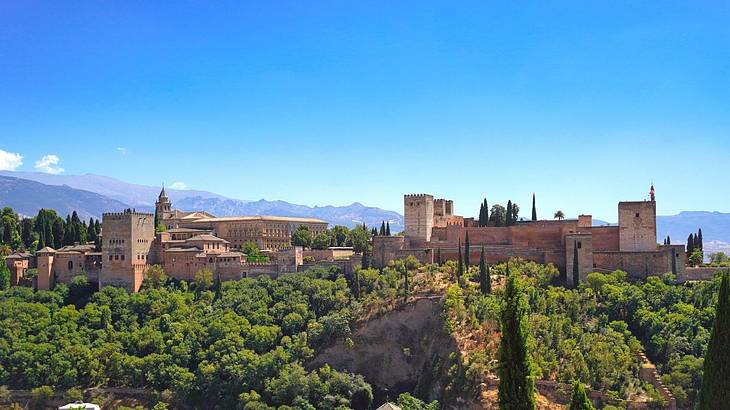
The name Alhambra comes from the Arabic phrase, al-Qal'a al-Hamra, meaning the "red fort," a reference to the color of its walls. Muhammad I ibn al-Ahmar, founder of the Nasrid dynasty, moved his court to the Sabika hill in 1238 and began building. Most of the Alhambra seen today dates from the 14th century.
Three Nasrid palaces make up the royal complex: the Mexuar, used for administration; the Palace of Comares, built by Yusuf I; and the Palace of the Lions, built by Muhammad V. Charles V added a Renaissance palace alongside them in the 16th century. Visiting the Alhambra is a must on any Granada itinerary.
☂️ Visit the Alhambra on a tour
- Granada - Alhambra Guided Tour Including Nasrid Palaces (usually sells out)
- Granada - Alhambra Guided Tour With Nasrid Palaces & Gardens (widely sought after)

Castell de Bellver
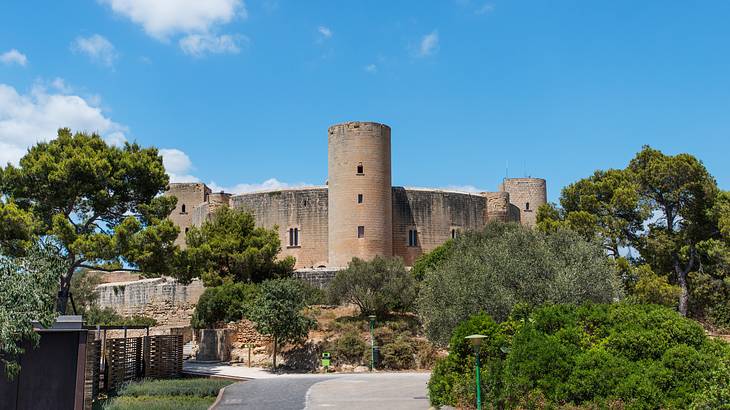
Circular castles are rare in Europe, and this one on a hilltop above Palma is among the very few. King Jaume II of Mallorca ordered it built, with work running from 1300 to 1311 under architect Pere Salvà. Its name comes from Catalan words meaning "lovely view."
A central courtyard sits inside the ring, with three towers attached to the main structure and a fourth freestanding keep linked by a bridge. The castle served as a royal residence, then as a prison from 1717 to 1915, and now holds Palma's history museum. It is a family-friendly activity to do in Palma.
☂️ Explore the Castell de Bellver on a tour
- Palma de Mallorca - One-Hour Sightseeing Boat Tour (usually sells out)
- Three Hours E-Bike Tour in Palma (top-rated tour)
Cuevas del Drach
Four connected caves run beneath the coast near Porto Cristo, reaching a depth of 25 meters and extending several kilometers. They are named the Black Cave, the White Cave, the Cave of Luis Salvador, and the Cave of the French. French speleologist Edouard-Alfred Martel surveyed them in 1896.
Lake Martel lies at the end of the 1,200-meter visitor route and measures 117 meters long and 30 meters wide. Classical concerts have been performed on the water since 1935, played from illuminated boats. Photography is prohibited during the concert.
☂️ See the Drach Caves on a tour
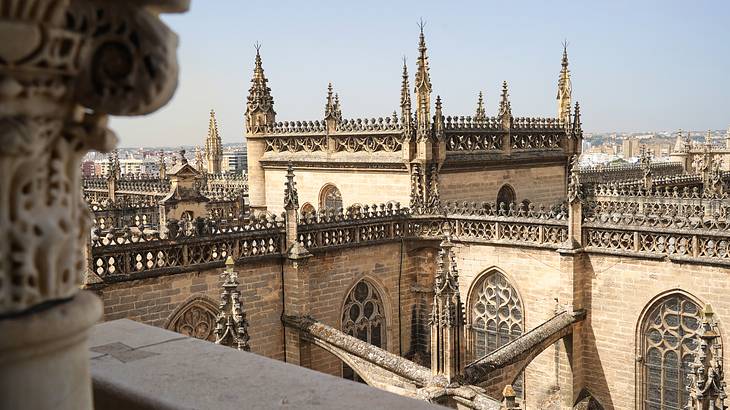

Catedral de Sevilla
Seville's cathedral chapter resolved in 1401 to demolish the Almohad mosque on this site and replace it with something grander. Construction ran till about 1506. The Catedral de Sevilla is now the largest Gothic cathedral in the world.
The Giralda bell tower is the mosque's original minaret, topped with a Renaissance belfry in 1568. Christopher Columbus is buried in the cathedral, with four bronze kings carrying his tomb. The Seville Cathedral became a UNESCO World Heritage Site in 1987, and is a must-visit on any Seville itinerary.
Plaza de España
Architect Anibal Gonzalez designed this half-moon plaza for the 1929 Ibero-American Exposition, completing it in 1928 inside Parque de Maria Luisa. Brick, ceramic tile, and wrought iron combine in a Spanish Renaissance and Moorish revival style.
Four bridges cross the canal that curves through the square, each representing one of the ancient kingdoms of Spain. Tiled alcoves run along the base of the building, one for every Spanish province, each showing a map and a historical scene. The plaza now houses government offices and has appeared in several films.
☂️ Explore the Plaza de España on a tour
- Cities of Andalusia Four-Day Tour From Madrid (top-rated tour)
- Tour Welcome to Seville in Eco Tuk Tuk Private With Local Guide (popular with most)
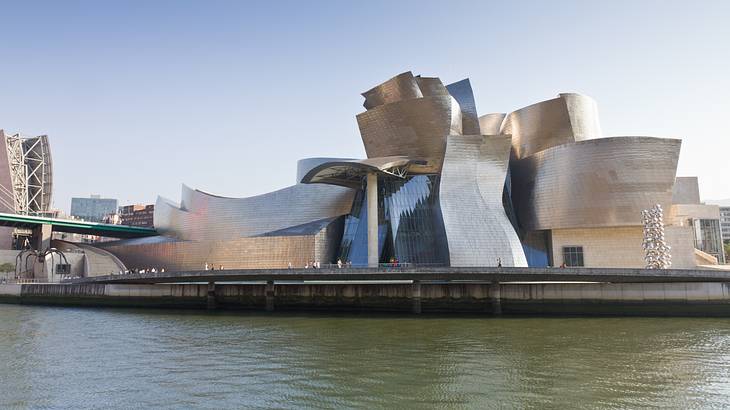

Museo Guggenheim Bilbao
Frank Gehry's Guggenheim Museum opened on the 18th of October, 1997, and is widely credited with transforming Bilbao from a declining industrial port into a cultural destination. The effect became so well documented that urban planners now refer to it as the "Bilbao effect."
Roughly 33,000 titanium sheets clad the building's curves, each panel barely a third of a millimeter thick and cut individually for its position. Limestone covers the rectangular sections, and glass links the two. Gehry used aerospace software to translate the geometry into a buildable form. This museum is a must-see on any Spain itinerary.
☂️ Explore the Guggenheim Museum Bilbao with a tour
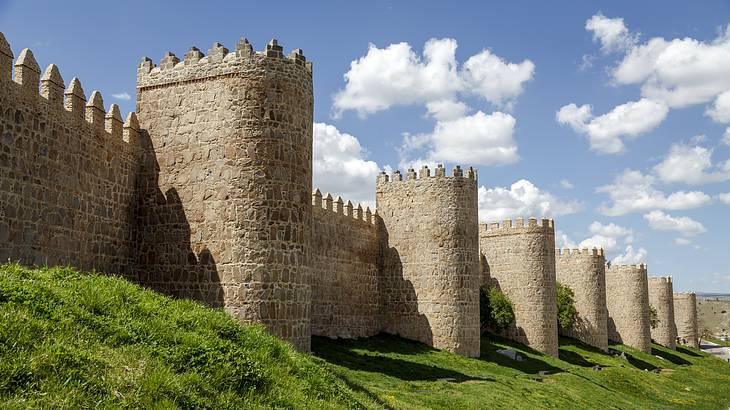

Muralla de Ávila
Ávila's walls form a complete circuit around the old town, and they are among the best-preserved medieval fortifications in Europe. Work began in 1090, with most of the structure rebuilt during the 12th century. The rest was completed in stages until the 14th century.
The perimeter measures 2,516 meters and encompasses 87 turrets, nine gates, and around 2,500 merlons along the parapet. The walls average three meters thick and twelve meters high. Spain declared Ávila a national monument on the 24th of March, 1884, and UNESCO listed the old town and its extramural churches in 1985.
☂️ Explore the Muralla de Ávila with a tour
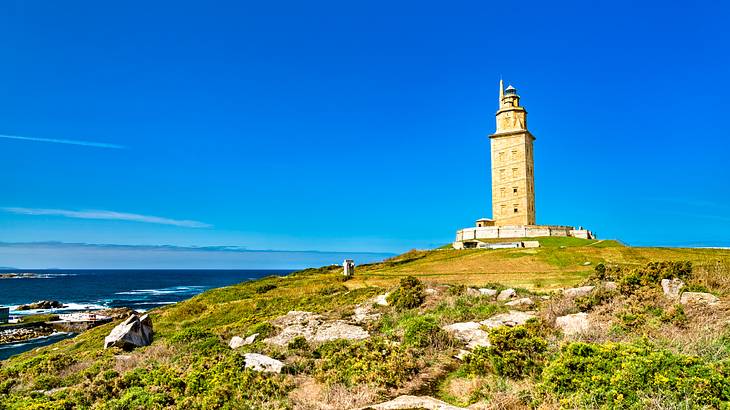

Torre de Hércules
The Romans built this lighthouse at the entrance to the harbor of A Coruña in the late 1st century AD, naming it the Farum Brigantium. It is the only surviving lighthouse from Greco-Roman antiquity that still operates, and it has guided ships more or less continuously since the 2nd century.
The tower rises 55 meters from a rock that is already 57 meters high. Roman masonry accounts for 34 meters, with the upper 21 meters added during Eustaquio Giannini's 18th-century restoration. The Tower of Hercules became a UNESCO World Heritage Site in 2009.

Castillo de Colomares
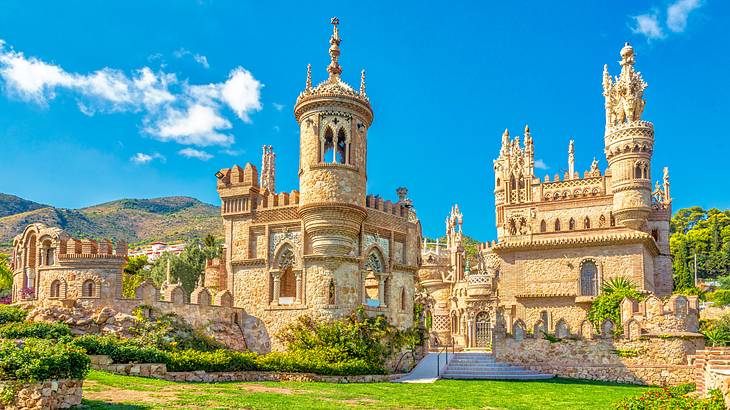
Nothing about this castle in Benalmadena is what it appears. The turrets, arches, and spires suggest centuries of history, but construction ran only from 1987 to 1994, under the direction of American doctor Esteban Martin y Martin, with two local bricklayers.
The building is a monument to Christopher Columbus, and its architecture deliberately mixes Byzantine, Romanesque, Gothic, and Mudejar elements to represent the cultures present in Spain during his lifetime. Carvings and sculptures throughout retell the story of his voyages. A chapel inside is often cited as one of the smallest churches in the world.

Catedral de Burgos
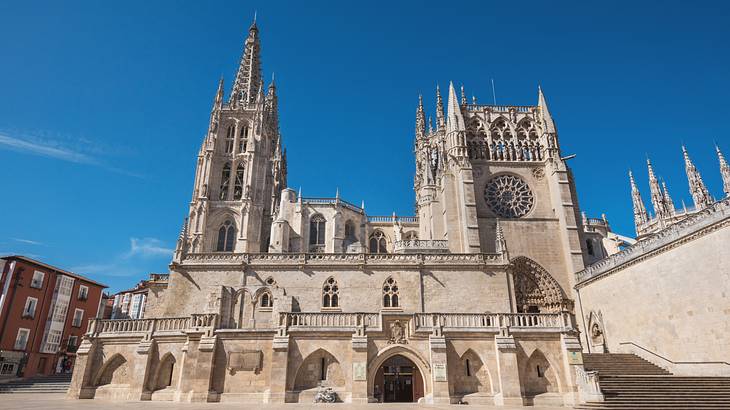
Construction of this cathedral began in 1221 under Bishop Mauricio and King Ferdinand III, following French Gothic models drawn from Paris and Reims. The spires and the octagonal Constable Chapel were added in the 15th century by German and Burgundian masters.
It is the only Spanish cathedral inscribed by UNESCO in its own right, rather than as part of a wider historic center. The Papamoscas, a mechanical figure that opens its mouth every hour, sits within the church.

Santa Maria de Montserrat
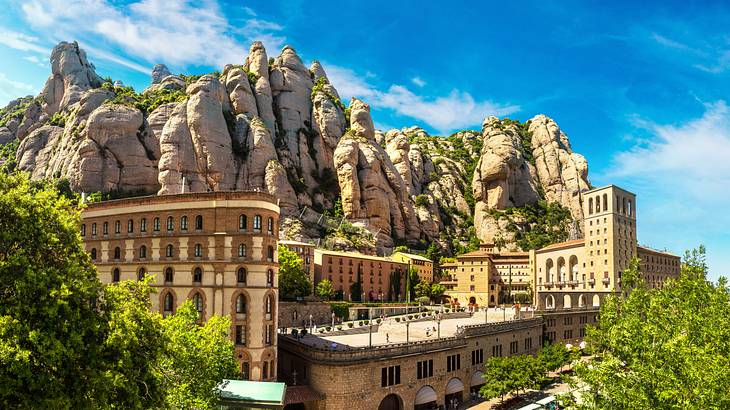
A Benedictine community has occupied this ledge on the serrated mountain of Montserrat since 1025. Napoleonic troops destroyed much of the complex in 1811 and 1812, so most of what stands is a 19th- and 20th-century rebuild around the surviving basilica.
The statue of the Virgin of Montserrat, known as La Moreneta, sits above the altar and is the Patron Saint of Catalonia. The Escolania choir school attached to the monastery dates to the 14th century and is one of the oldest in Europe. Boys from the school sing in the basilica most days.

Casas Colgadas
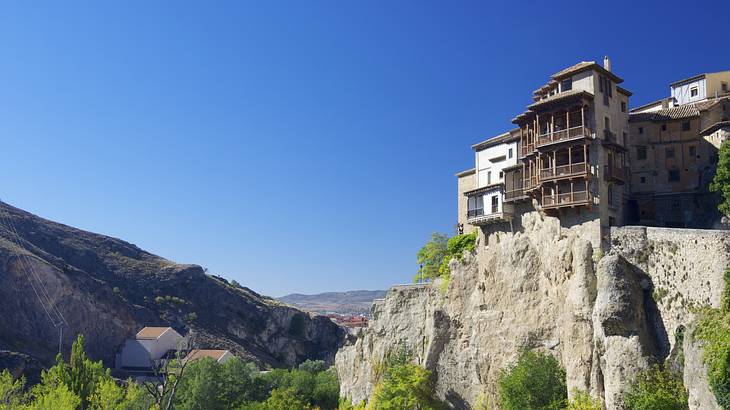
Balconies project straight out over a gorge in Cuenca, with nothing but rock and air beneath them. These hanging houses date from the 15th century, and while many once lined the cliff edge, only a handful survive after centuries of collapse and rebuilding.
The wooden balconies were last restored in the 1920s, and the buildings now hold an abstract art museum. Cuenca's walled old town was listed by UNESCO in 1996. A footbridge across the gorge gives the clearest view of the surrounding landscape.

Alcázar de Toledo
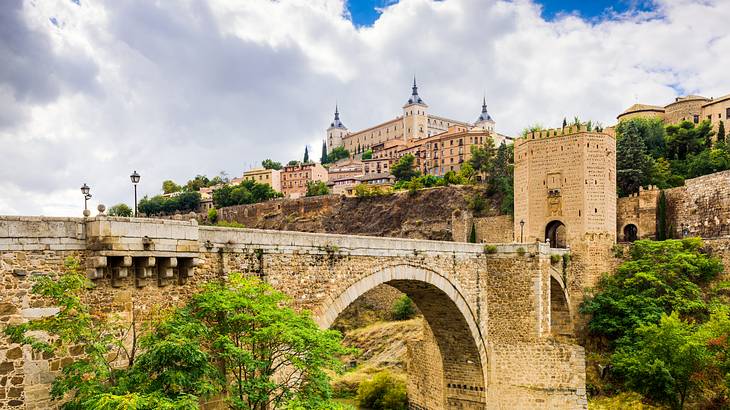
Toledo's highest point has been fortified since Roman times, and the square fortress standing here now was rebuilt for Charles V in the 16th century, with facades by Alonso de Covarrubias and Juan de Herrera. Its four corner towers make the building visible from every vantage point in the city.
Nationalist forces held the Alcazar during a siege in 1936, and artillery reduced much of it to rubble. The reconstruction that followed restored the 16th-century exterior. The building now houses the Army Museum and the regional library, with excavated foundations from earlier structures visible below ground level.
In Summary
Spain's landmarks bear witness to a long sequence of arrivals. The Romans left a working lighthouse, the Umayyad rulers built a mosque that now houses a cathedral, and the Nasrid sultans raised palaces in Granada. Gaudí also spent his career reshaping what a building could look like.
Many of these sites require tickets to be booked well in advance, and attractions like the Alhambra and Sagrada Familia limit visitor numbers. Check what each place requires before you travel, and give the larger locations more time than you think they need.

Want to keep exploring?
Subscribe for our latest guides.
Thank you for subscribing
We will be in touch soon with our latest guides.
Want to keep exploring?
Subscribe for our latest guides.
Thank you for subscribing
We will be in touch soon with our latest guides.