
10 Cancun Landmarks and Historical Sites Worth Visiting

Destguides may receive commissions from purchases made through affiliate links in this article.
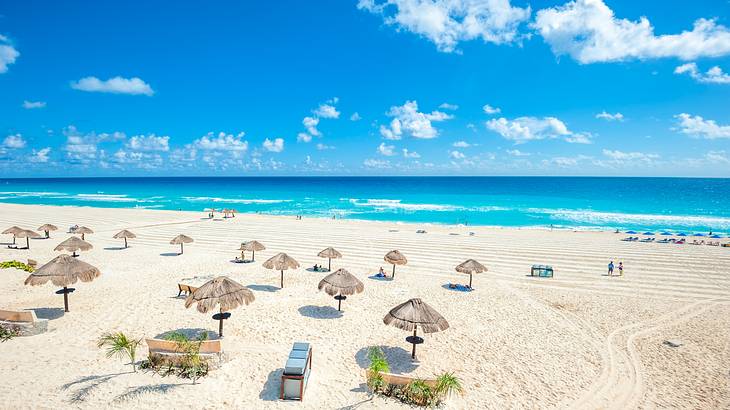

Cancun sits on the northeastern coast of the Yucatan Peninsula. The city was once home to the Maya, whose temples still dot the Hotel Zone and surrounding area.
Several archaeological sites survive within the city, alongside an underwater art museum, a rotating observation tower, and the first church built during Cancun's founding years.
This guide covers 10 Cancun landmarks and historical sites to visit. Keep reading to discover which ones to add to your itinerary.
Planning a last-minute trip to Cancún?
Before traveling to Cancún, book your entrance tickets and tours ahead of time. See the short list of top suggestions below.
☂️ Top tours and experiences in Cancún
- Chichen Itza, Cenote, & Valladolid Tour (very popular)
- Cancun ATV Jungle Adventure, Ziplines, Cenote & Tequila Tasting (very popular)
- Hip Hop Sessions Boat Party Cancun (very popular)
- Cancun ATV, Zipline, Cenote, Horseback Riding & Tequila Tasting
- Isla Mujeres Cruise With Beach Club, Snorkel, Lunch & Open Bar
10 Landmarks in Cancun, Mexico
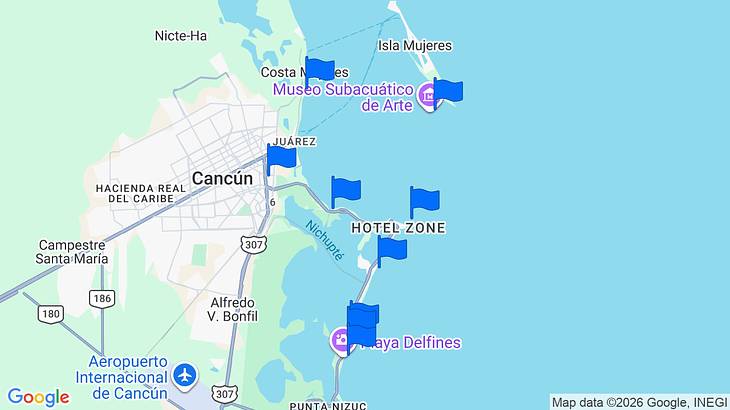
Cancún Landmarks Map
A map of Cancún landmarks. Use the map to explore all of the points of interest.
Cancun Scenic Tower
Rising 262 feet (80 meters) above the Hotel Zone, the Cancun Scenic Tower is the tallest observation point on the Riviera Maya. Known locally as Torre Escenica, the tower features a rotating capsule offering 360-degree views of the Caribbean Sea, Nichupte Lagoon, and Isla Mujeres on the horizon.
The tower is operated by Grupo Xcaret, and visitors with wristbands from any Xcaret experience can ride it for free as part of their package.
Tip: Visit this attraction near sunset. Cancun faces east, so the most dramatic colors appear over the lagoon and downtown skyline to the west.
Dolphins Beach
Cancun's largest public beach is also its most photographed. Playa Delfines, or Dolphins Beach, is named for the dolphins that can sometimes be spotted from shore, particularly in the early morning.
A natural elevation above the sand forms El Mirador, a lookout platform with panoramic views of the coastline and the Hotel Zone skyline. The colorful "CANCUN" sign installed here in 2009 has become one of the most recognizable photo spots in the city.
Tip: Entry and parking are free. The waves here tend to be stronger than at other Hotel Zone beaches, which draws surfers but requires caution for swimmers.

Cancun Underwater Museum
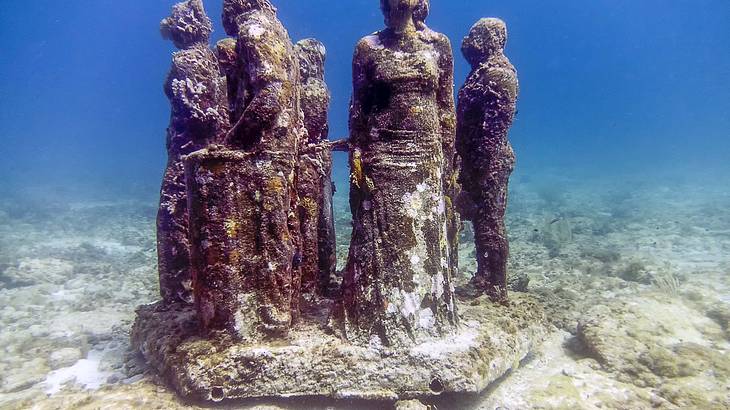
Few museums in the world require a snorkel or scuba tank to explore. MUSA (Museo Subacuatico de Arte) opened in 2009 as a collaboration between the National Marine Park of Cancun and British sculptor Jason deCaires Taylor, who created over 500 permanent, life-size concrete sculptures on the ocean floor off the coast of Cancun.
The museum is divided into galleries. The Manchones gallery lies at a depth of about 30 feet and is suitable for scuba divers. The Nizuc gallery near the southern Hotel Zone sits in shallower water and is accessible to snorkelers.
The sculptures are made from pH-neutral marine concrete designed to encourage coral growth. Over time, the installations become living reefs, blending art with marine conservation.
El Meco Archaeological Site
Just north of downtown Cancun, the El Meco ruins contain the tallest Mayan pyramid in the area. El Castillo stands roughly 41 feet tall, with two carved serpent heads flanking its main staircase in a style influenced by Chichen Itza.
El Meco was an important trade center before the arrival of Europeans. Its position directly across from Isla Mujeres suggests it served as a navigation point and port along Mayan maritime trade routes.
The site is divided into three plazas where you can explore the centuries-old structures. INAH (Mexico's National Institute of Anthropology and History) reopened El Meco in December 2024 with new infrastructure.

El Rey Archaeological Zone
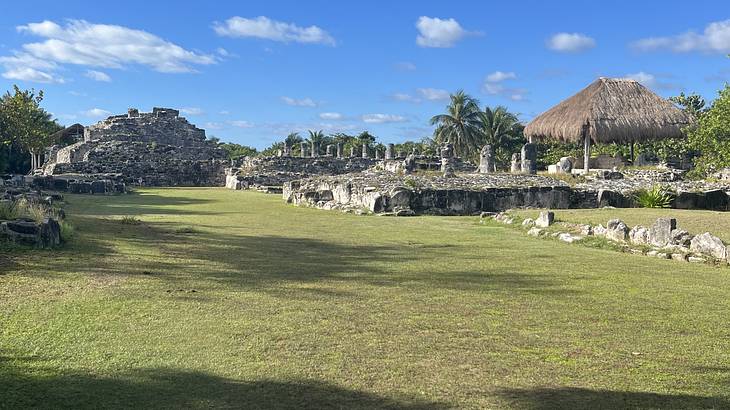
With 47 surviving structures, El Rey is the largest pre-Columbian site in the Cancun Hotel Zone. Most structures date back over five hundred years, and numerous ancient Mayan burials have been identified beneath the residential platforms.
El Rey was named in 1909 when travelers discovered a carved sculpture that appeared to depict royalty. That figure is now preserved in the Mayan Museum of Cancun.
Some stone walls still bear traces of original mural paintings. El Rey is also home to dozens of iguanas, which bask freely on the warm stones.
Iglesia de Cristo Rey
Cancun's first Roman Catholic church was built between 1970 and 1972, during the earliest phase of the city's development. The Iglesia de Cristo Rey stands near Parque de las Palapas in downtown Cancun, surrounded by peaceful gardens where open-air masses are sometimes held.
The design is modest compared to colonial Mexican churches. A hollow cross crowns the low white building, and a carved wooden crucifix hangs above the altar.
Services are offered in both Spanish and English, making the church a popular stop for travelers seeking a Sunday Mass or a quiet moment away from the Hotel Zone.
Mayan Museum of Cancun
Opened in 2012, the Museo Maya de Cancun houses approximately 3,500 artifacts from across the Yucatan Peninsula. Around 400 pieces are on display at any given time, rotated across three exhibition halls.
The first room is dedicated to local archaeology in Quintana Roo, featuring objects from sites such as El Meco, El Rey, and San Miguelito. The second shares a broader history of Mayan civilization. The third hosts temporary exhibits, which means repeat visits often reveal new material.
The museum also serves as the entrance to the San Miguelito archaeological site, accessible through the museum's garden paths.
☂️ Visit Museo Maya de Cancún y Zona Arqueológica de San Miguelito with a tour

San Miguelito Archeological Site
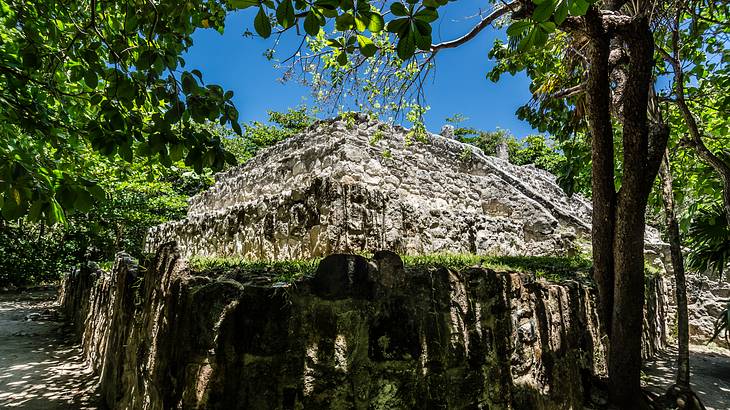
Right next to the Mayan Museum, the San Miguelito ruins take their modern name from a coconut ranch that operated on the site between 1950 and 1970. The original Mayan name has been lost.
Four main groupings make up the site: the North Complex, the Dragon Complex, the Chaak Palace, and the South Complex. A north-south path connects them, and it typically takes about an hour to walk through the different sections.
Chaak Palace is the most prominent structure, with spacious columned rooms that once served a ceremonial purpose. The site rarely draws large crowds, making it a quieter alternative to the bigger ruins in the region.
Yamil Lu'um
Tucked between the Park Royal Cancun and Westin Lagunamar resorts, this small Mayan site is one of the most overlooked historical landmarks in the Hotel Zone. Yamil Lu'um, meaning "hilly land" in Mayan, sits on the highest natural point along the Cancun coastline.
The Temple of the Scorpion (Templo del Alacran) is located here and is named after a scorpion sculpture inside. It dates to the Late Postclassic period, roughly between 1200 and 1550 AD. Visitors can access the ruins through the adjacent hotel grounds.

Punta Cancun Lighthouse
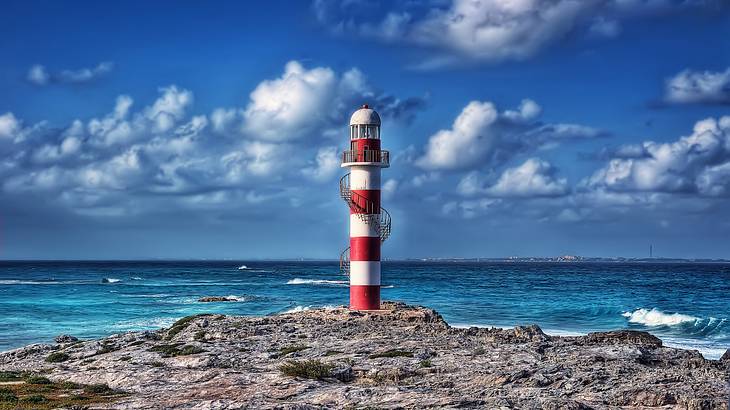
At the far northern end of the Hotel Zone, the red-and-white striped Punta Cancun Lighthouse stands on a rocky outcrop. The structure marks the bend where Boulevard Kukulcan curves along the Caribbean coast.
The external staircase spiraling its way to the top does not reach the ground, so the lighthouse is not accessible for tours. Even so, the surrounding rocks and shoreline make it a favorite spot among locals and visitors for photographs and sunsets.
Conclusion
Cancun has more historical depth than its resort reputation suggests. Mayan ruins sit steps from luxury resorts, and an underwater museum doubles as a living coral reef just off the coast.
From El Meco's serpent-carved pyramid to the iconic sign at Playa Delfines, these 10 landmarks are easy to reach from anywhere in the Hotel Zone or downtown.

Want to keep exploring?
Subscribe for our latest guides.
Thank you for subscribing
We will be in touch soon with our latest guides.
Want to keep exploring?
Subscribe for our latest guides.
Thank you for subscribing
We will be in touch soon with our latest guides.