
19 Famous Boston Landmarks You Must Visit

Destguides may receive commissions from purchases made through affiliate links in this article.

Boston was founded in 1630 and grew into one of colonial America's most influential cities. The Boston Massacre, the Boston Tea Party, and the first battles of the Revolutionary War all took place here or nearby.
These famous Boston landmarks cover nearly four centuries, from the country's oldest public park to its oldest active ballpark. Keep reading to explore the sites that make this Massachusetts capital one of America's most historically rich cities.
Planning a last-minute trip to Boston?
Book your entrance tickets and tours for your trip to Boston early! We've pulled together top suggestions below.
☂️ Top tours and experiences in Boston
- City Cruises Boston Whale Watching Cruise by High-Speed Boat (likely to sell out)
- Boston Duck Boat Sightseeing City Tour With Cruise (very popular)
- Freedom Trail History Small Group Walking Tour (very popular)
- Boston to Martha's Vineyard Day Trip With Optional Island Tour (very popular)
- Boston Hop-On Hop-Off Trolley Tour With 13 Stops
19 Famous Landmarks in Boston
- Museum of African American History
- Symphony Hall
- Boston Common
- Boston Irish Famine Memorial
- Boston Public Library
- Boston Public Garden
- Boston Tea Party Ships & Museum
- Charles River Esplanade
- Faneuil Hall Marketplace
- Granary Burying Ground
- Isabella Stewart Gardner Museum
- Massachusetts State House
- Old North Church & Historic Site
- Old South Meeting House
- Old State House
- The Paul Revere House
- The New England Holocaust Memorial
- USS Constitution Museum
- Fenway Park
Boston Landmarks Map
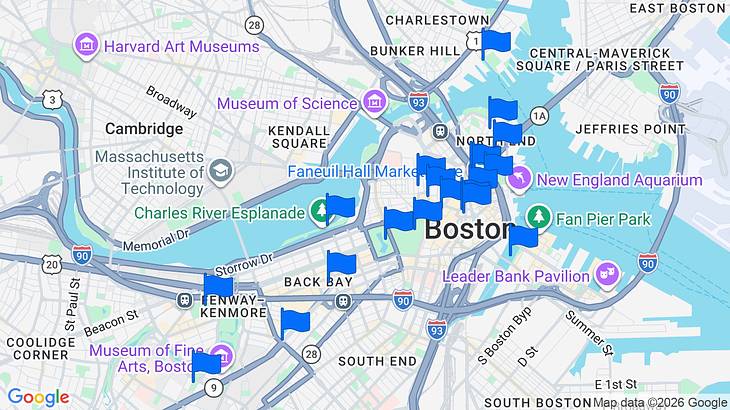
A map of Boston landmarks. Use the map to explore all of the points of interest.
Museum of African American History
The African Meeting House, built in 1806, is the oldest surviving Black church building in the United States. Boston's free Black community used it as a church, school, and political gathering place. Abolitionists Frederick Douglass and William Lloyd Garrison both spoke here.
Next door, the Abiel Smith School opened in 1835 as the first building built specifically to educate Black children in Boston. Together, the two structures form the Museum of African American History.
Both buildings sit on Boston's Black Heritage Trail, a walking route through Beacon Hill that traces the neighborhood's 19th-century Black community. Ranger-guided tours of the trail run seasonally through the National Park Service.
Symphony Hall
Since opening on October 15, 1900, Symphony Hall has been the permanent seat of the Boston Symphony Orchestra. Harvard physicist Wallace Clement Sabine served as acoustical consultant, making it among the first concert halls designed using scientific acoustical principles.
Those acoustics still place it alongside Vienna's Musikvereinssaal and Amsterdam's Concertgebouw among the finest concert venues in the world. The hall was designated a National Historic Landmark in 1999.
The Boston Pops and visiting performers from around the globe also take the stage here. Checking the performance calendar before your trip is worthwhile, as the lineup shifts frequently.
☂️ Visit Symphony Hall with an experience
- Boston's Historic Electric Bike Tour (highly rated)
- Boston Hop-On Hop-Off Trolley Tour With 13 Stops (a top tour)

Boston Common
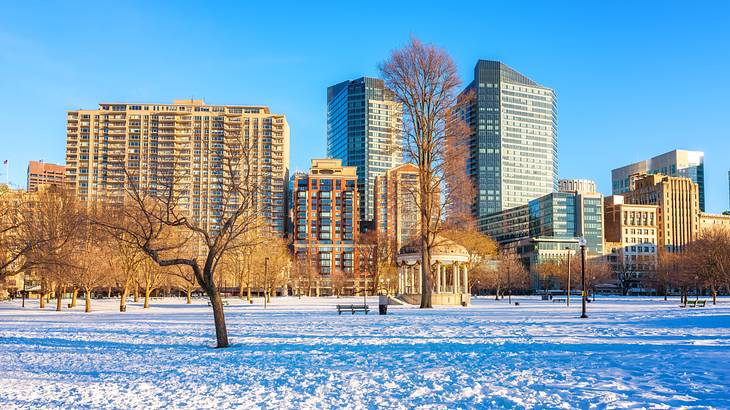
Established in 1634, Boston Common is the oldest public park in the United States. Puritan colonists purchased the land for communal use, and it served as a grazing pasture, a military training ground, and a public execution site for nearly two centuries.
British Redcoats encamped here beginning in 1768. After independence, the space gradually shifted to public recreation, and cattle grazing ended in 1830.
Boston Common marks the start of the Freedom Trail, the 2.5-mile walking route connecting 16 historic sites across the city. The Frog Pond converts to an ice-skating rink each winter.
☂️ Visit Boston Common with an excursion
Boston Irish Famine Memorial
When famine devastated Ireland beginning in 1845, Boston became a major entry point for refugees. In 1847 alone, around 37,000 Irish immigrants arrived in the city, many impoverished and ill.
Unveiled in 1998, the memorial features two contrasting bronze groups by sculptor Robert Shure: one depicting a starving family in Ireland, the other a family beginning a new life in America. Eight narrative plaques encircle the statues, tracing the famine's causes and aftermath.
The memorial sits at the corner of Washington and School streets, along both the Freedom Trail and the Irish Heritage Trail.

Boston Public Library
Founded in 1848, the Boston Public Library was the first large, free municipal library in the United States. It was also the first public library to lend books and the first to open a branch location.
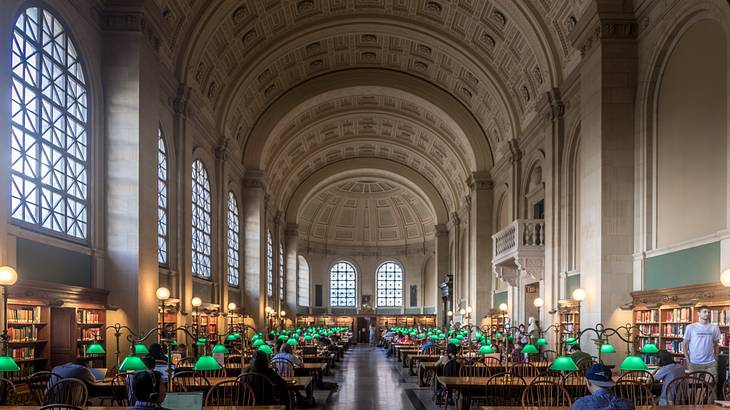
The central location on Copley Square includes the 1895 McKim Building, designed by Charles Follen McKim. Inside, the Bates Hall reading room features a 50-foot barrel vault ceiling, and John Singer Sargent's murals are worth seeking out.
Free daily art and architecture tours cover highlights in both the McKim Building and the adjacent building opened in 1972, which houses circulating collections and modern programming spaces.
Boston Public Garden
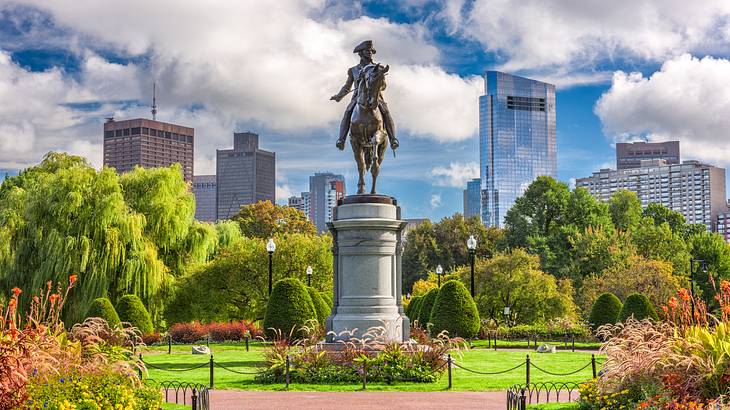
Adjacent to Boston Common but entirely different in character, the Boston Public Garden became the first public botanical garden in the United States when it was established in 1837. While the Common was practical, the garden was decorative from the start, with paths built for strolling.
The Victorian-era design reflects the period's enthusiasm for horticultural experimentation. Dozens of tree varieties grow here, and a four-acre lagoon sits at the garden's center.
The Swan Boats have glided across that lagoon since 1877, operated by the same family for generations. An equestrian statue of George Washington stands 38 feet tall at the Arlington Street entrance.

Boston Tea Party Ships & Museum
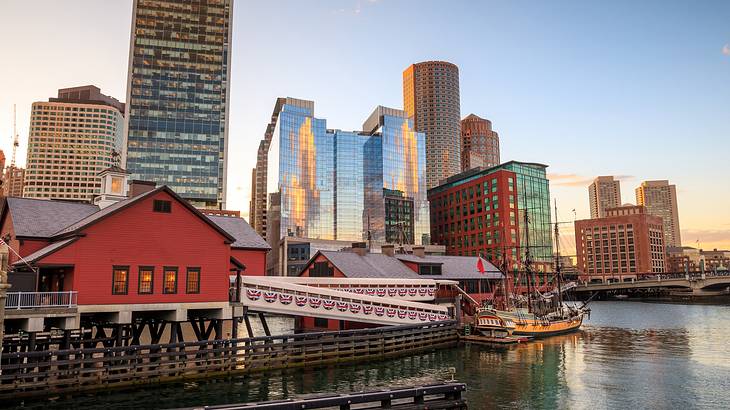
On December 16, 1773, colonists disguised as Mohawk warriors boarded three ships in the harbor and dumped 342 chests of tea overboard in protest of taxation without representation. The act became one of the defining moments before the American Revolution.
The original ships no longer exist, but the Boston Tea Party Ships and Museum recreates the event through replica vessels and interactive exhibits. Live actors portray the debates that led to the protest.
The museum sits on the Fort Point Channel along the Congress Street Bridge. Arriving early on weekdays helps avoid crowds, since the interactive format limits group sizes.
☂️ Visit Boston Tea Party Ships & Museum with an excursion
- Boston Tea Party Ships & Museum Admission (often fully booked)

Charles River Esplanade
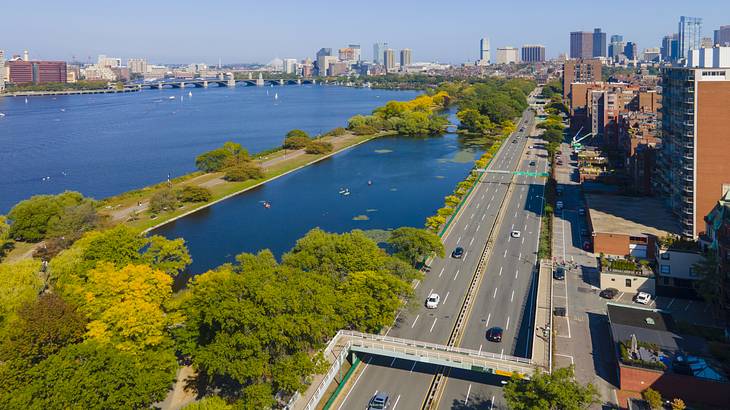
A ribbon of green stretching along the south bank of the Charles River, the Esplanade offers three miles of pathways for running, cycling, and walking. Public art, playgrounds, and community docks line the route.
In summer, the Hatch Memorial Shell hosts free outdoor concerts, including the Boston Pops Fourth of July performance. Locals claim their spots on the lawn hours in advance for this one.
The path offers clear views across the water toward Cambridge and MIT, especially at sunset. It is a welcome change of pace from the brick and cobblestone of the Freedom Trail.

Faneuil Hall Marketplace
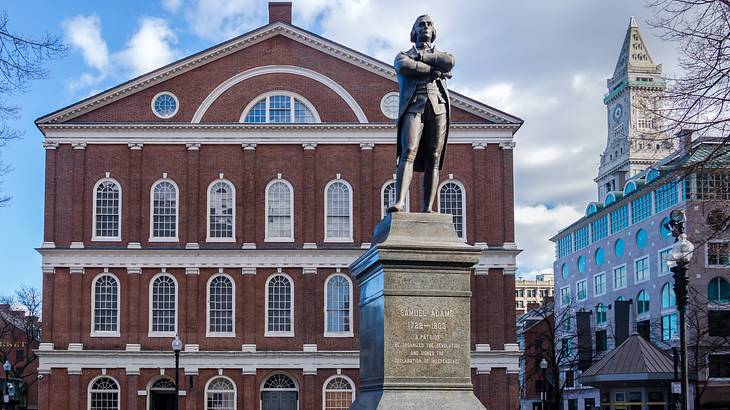
Merchant Peter Faneuil built this hall in 1742 as both a marketplace and a public assembly space. Known as the "Cradle of Liberty," it hosted speeches by Samuel Adams, James Otis, and later Frederick Douglass, making it a continuous thread in the story of American civil rights.
Architect Charles Bulfinch expanded the building in 1806, nearly tripling its size while preserving that dual purpose. The Great Hall on the upper floor, where many of those speeches took place, is still open to visitors.
Faneuil Hall is a stop on the Freedom Trail and sits near Quincy Market, making it a natural midpoint for a walking tour of the city.

Granary Burying Ground
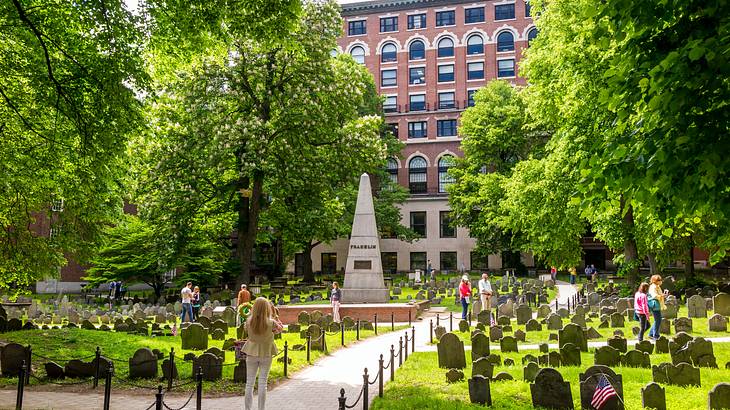
Three signers of the Declaration of Independence rest in the Granary Burying Ground: John Hancock, Samuel Adams, and Robert Treat Paine. Paul Revere and the victims of the Boston Massacre are also buried here.
Established in 1660, the burying ground takes its name from a grain storage building that once stood nearby. About 2,300 headstones remain, though the actual number of burials is believed to be far higher.
The site sits on Tremont Street near Park Street Church and is compact enough to walk through in under 20 minutes. The oldest headstones feature carved skull-and-crossbones motifs typical of Puritan burial art.
Isabella Stewart Gardner Museum
Art collector Isabella Stewart Gardner spent decades assembling a world-class collection before opening her Venetian-style museum on January 1, 1903. She modeled the building around an interior courtyard inspired by a 15th-century Venetian palazzo.
Works by Titian, Botticelli, Raphael, Rembrandt, and Vermeer fill the galleries. In 1990, two thieves disguised as police officers stole 13 pieces, including three Rembrandts and a Vermeer. The crime remains unsolved.
Gardner's will requires the collection stay exactly as she arranged it, so empty frames still hang where the stolen works once were. Visitors with the name Isabella get in free — a quirk of the museum's admission policy.
☂️ Discover Isabella Stewart Gardner Museum on a tour

Massachusetts State House
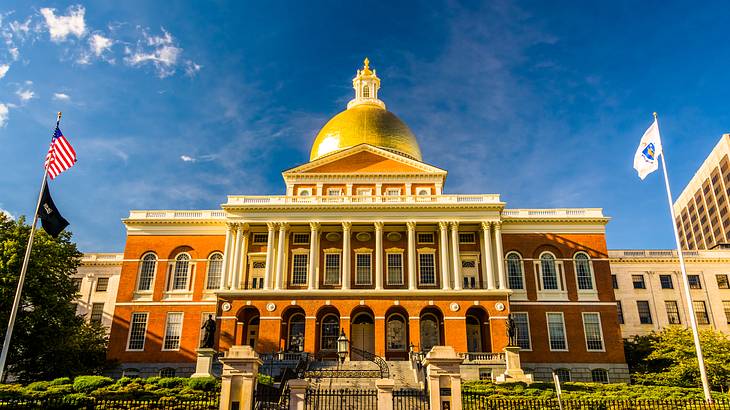
Architect Charles Bulfinch designed the Massachusetts State House, completed in 1798 on land once owned by John Hancock. The Federal-style building has housed the state legislature for over two centuries and sits at the top of Beacon Hill.
Its dome is the most recognizable feature. Originally made of wood, it leaked and was covered in copper by Paul Revere and Son in 1802. Gold leaf replaced the copper in 1874, and the dome was most recently re-gilded with 23-karat gold in 1997.
Free guided tours run on weekdays and cover the interior, including Nurses Hall with its Italian marble walls and murals of revolutionary events.

Old North Church & Historic Site
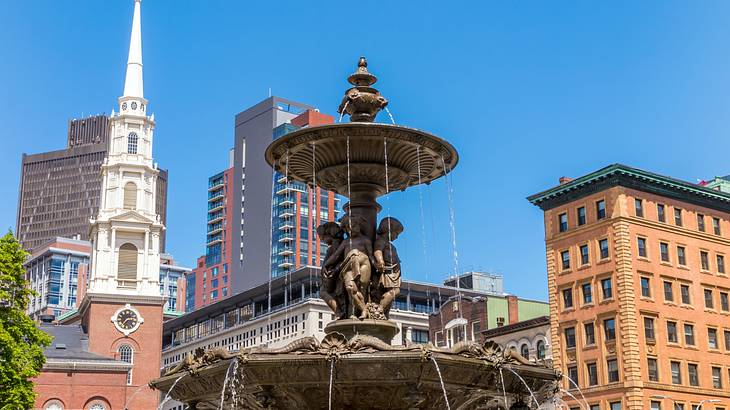
On the night of April 18, 1775, sexton Robert Newman and vestryman John Pulling climbed the steeple and held up two lanterns, signaling that British troops were crossing the Charles River by boat. Henry Wadsworth Longfellow later immortalized the moment with the line "one if by land, two if by sea."
That signal launched a network of riders, Paul Revere among them, who spread the warning to Lexington and the surrounding countryside. The Battles of Lexington and Concord began the next morning.
Built in 1723, Old North Church is the oldest standing church in Boston. Its 191-foot steeple remains the tallest in the city.

Old South Meeting House
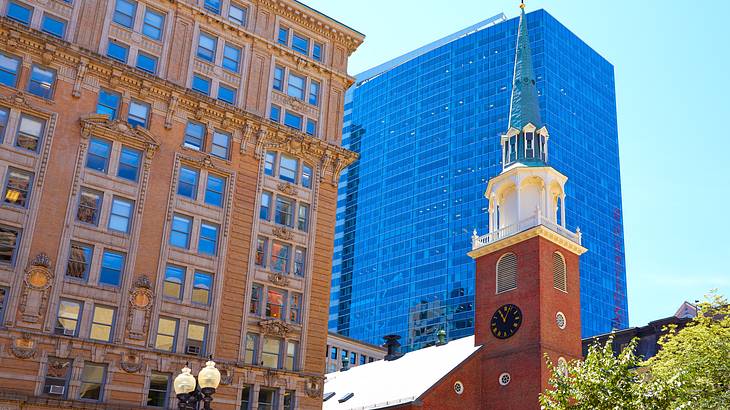
An estimated 5,000 colonists packed into the Old South Meeting House on December 16, 1773, to protest the British tea tax. When the royal governor refused to let the tea ships leave the harbor, the crowd's anger spilled into the streets and became the Boston Tea Party.
Completed in 1729, the building was the largest in colonial Boston. British troops later gutted the interior and used it as a riding school during their occupation of the city.
Saved from demolition in 1876, the Old South Meeting House became a museum the following year. It continues to host lectures and public programs on free speech and civic action.

Old State House
British soldiers fired into a crowd near the Old State House on March 5, 1770, killing five colonists in what became known as the Boston Massacre. Samuel Adams and Paul Revere framed the incident as the murder of innocents, helping galvanize colonial opposition to British rule.
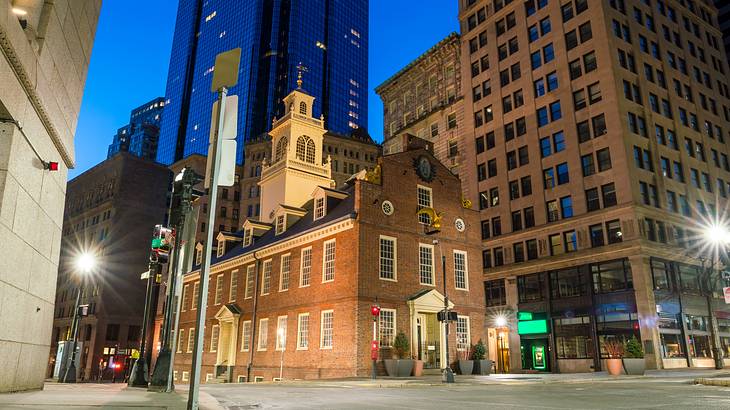
Built in 1713, the Old State House served as the seat of colonial government. The Declaration of Independence was first read to Bostonians from its balcony on July 18, 1776.
A circle of cobblestones on the pavement marks the massacre site. The building now operates as a museum, dwarfed by the modern towers around it — one of the more striking contrasts along the Freedom Trail.
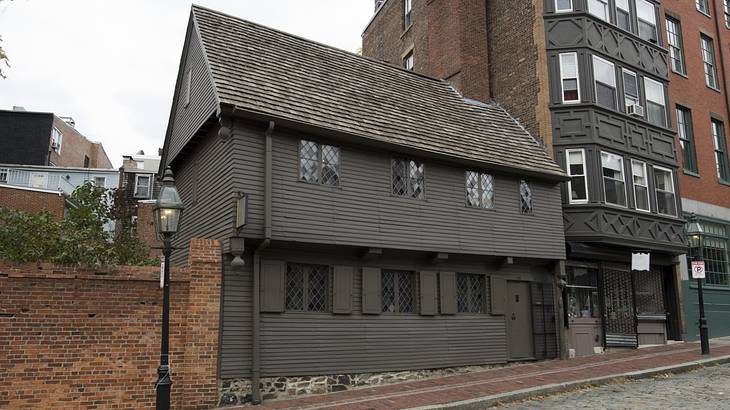

The Paul Revere House
Built around 1680, the Paul Revere House is the oldest remaining structure in downtown Boston. Revere lived here with his family from 1770 to 1800, and it was from this North End home that he set out on his famous midnight ride on the night of April 18, 1775.
After Revere moved out, the building served as a boarding house, a grocery, and a cigar factory. It was restored to its 17th-century appearance in 1908, with about 90 percent of the original structure still intact.
The Paul Revere House is the only residential building on the Freedom Trail. Period furnishings and examples of Revere's silverwork inside offer a window into colonial daily life.
☂️ Discover The Paul Revere House on a tour
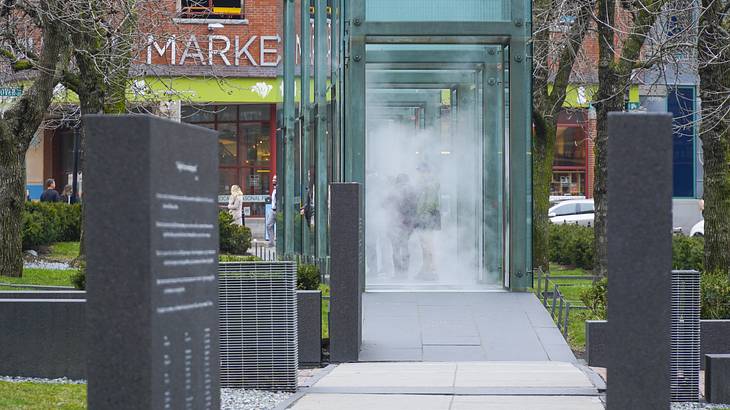

The New England Holocaust Memorial
Six glass towers rise 54 feet above a black granite pathway near Faneuil Hall. Each tower in the New England Holocaust Memorial represents one of the six major Nazi extermination camps: Majdanek, Chelmno, Sobibor, Treblinka, Belzec, and Auschwitz-Birkenau.
Six million numbers are etched across the glass panels, representing the Jewish victims of the Holocaust. Inside each tower, steam rises from a lit pit below, and the walls carry quotes from survivors.
The memorial was completed in 1995. The memorial is free, open at all hours, and its impact deepens after dark when the towers are illuminated from within.
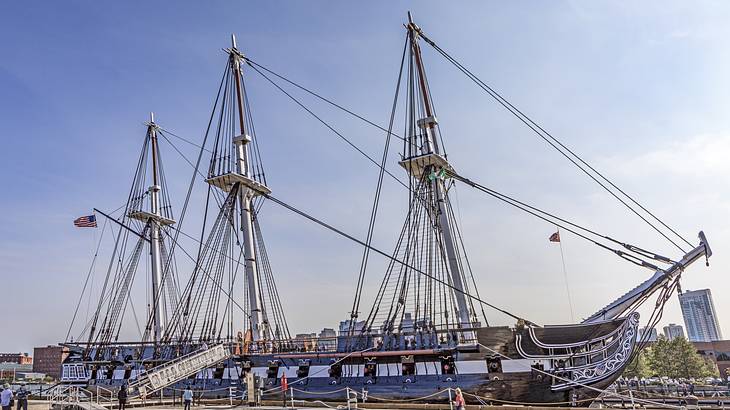

USS Constitution Museum
Launched in 1797, the USS Constitution is the oldest commissioned warship still afloat in the world. It earned the nickname Old Ironsides during the War of 1812, when British cannonballs bounced off its thick oak hull.
The U.S. Navy maintains the vessel at the Charlestown Navy Yard, where active-duty sailors lead free tours aboard the ship. An adjacent museum covers the history of this famous Massachusetts landmark through interactive exhibits and original artifacts.
The Charlestown Navy Yard sits at the far end of the Freedom Trail. Taking the ferry from Long Wharf is a good alternative to the long walk, and it gives you a harbor view of the ship on approach.
☂️ Experience USS Constitution Museum with a tour
- City Cruises Boston Historic Sightseeing Harbor Cruise (extremely popular)
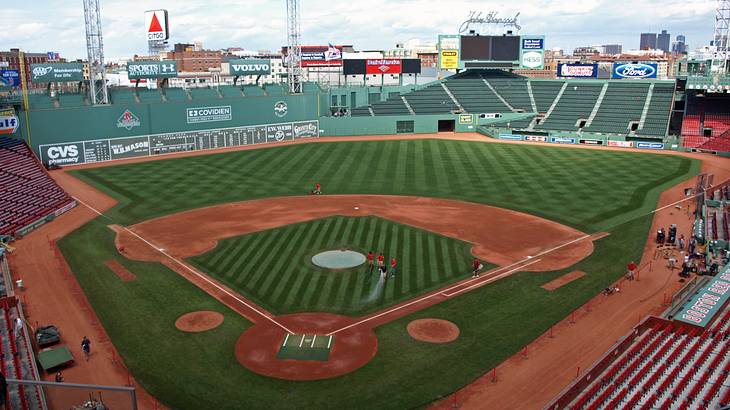

Fenway Park
Opened on April 20, 1912, Fenway Park is the oldest active ballpark in Major League Baseball. It has been home to the Boston Red Sox for over a century and draws visitors from around the world year-round.
The Green Monster, the 37-foot-tall left-field wall, is Fenway's most recognized feature. Originally built to block the view from Lansdowne Street, it was painted green in 1947 and still holds a hand-operated scoreboard updated manually during every game.
Stadium tours run year-round and include access to the press box and the Monster seats atop the wall. On game days, arriving early enough to watch batting practice is part of the experience.
☂️ Visit Fenway Park with an excursion
Conclusion
Boston has been shaping American history since 1630, and these 19 landmarks are the proof. The Freedom Trail alone connects colonial burying grounds, revolutionary sites, and the city's oldest standing church.
Beyond the trail, the Public Garden, the Gardner Museum, and Fenway Park prove Boston's landmarks go well beyond the Revolutionary War.

Want to keep exploring?
Subscribe for our latest guides.
Thank you for subscribing
We will be in touch soon with our latest guides.
Want to keep exploring?
Subscribe for our latest guides.
Thank you for subscribing
We will be in touch soon with our latest guides.