
24 Famous Landmarks in Thailand to Visit

Destguides may receive commissions from purchases made through affiliate links in this article.
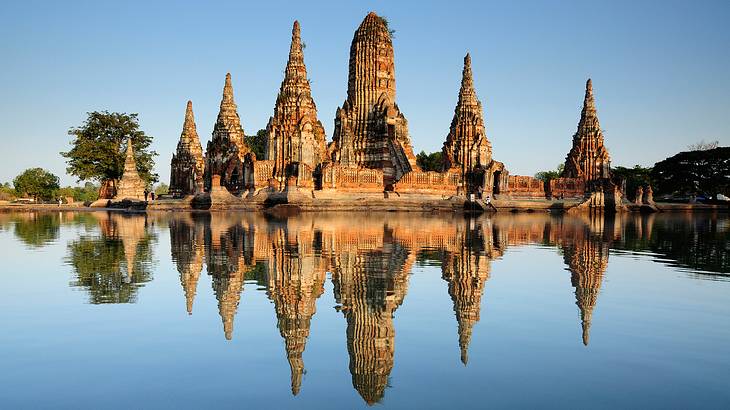

Thailand draws millions of visitors each year with a mix of ornate temples, ancient ruins, jungle-covered mountains, and a coastline that stretches across two seas.
The country's landmarks span roughly seven centuries of history, from the 13th-century walls of Chiang Mai to the gilded spires of Bangkok and the weathered prangs of Ayutthaya.
Whether you are drawn to royal palaces, forested national parks, or the limestone karsts of the Andaman coast, there is no shortage of places worth your time.
This list covers 24 famous landmarks in Thailand to help you plan your next trip. Continue reading to find the ones that suit your interests.
Organizing a last-minute visit to Thailand?
When visiting Thailand, book your entrance tickets and tours before you go. Below are some top recommendations to get you started.
☂️ Top tours and experiences in Thailand
- Koh Samui - Viewpoint, Elephant, Pig Island & Snorkel Lunch (rated highly)
- Bangkok - Suvarnabhumi Airport Fast-Track Service & Assistant (very popular)
- The Newest Luxury Five-Star Bangkok Chao Phraya Dinner Cruise (very popular)
- Koh Samui - mu ko Ang Thong Park Cruise With Kayaking Option (very popular)
- Phi Phi Islands Adventure Day Trip w Seaview Lunch by VMarine
24 Famous Thailand Landmarks
- The Grand Palace
- Wat Phra Kaew
- Erawan National Park
- Wat Rong Khun
- Wat Mahathat
- Big Buddha Phuket
- Lumphini Park
- Khaosan Road
- Koh Phi Phi Islands
- Sukhothai Historical Park
- Railay Beach
- Wat Phra That Doi Suthep
- The Sanctuary of Truth Museum
- Wat Arun
- Wat Phra Chetuphon
- Khao Sok National Park
- Doi Inthanon National Park
- Tha Phae Gate
- Phanom Rung Historical Park
- Wat Chaiwatthanaram
- Ao Phang Nga National Park
- Tarutao National Park
- Bang Pa-In Palace
- Khao Yai National Park
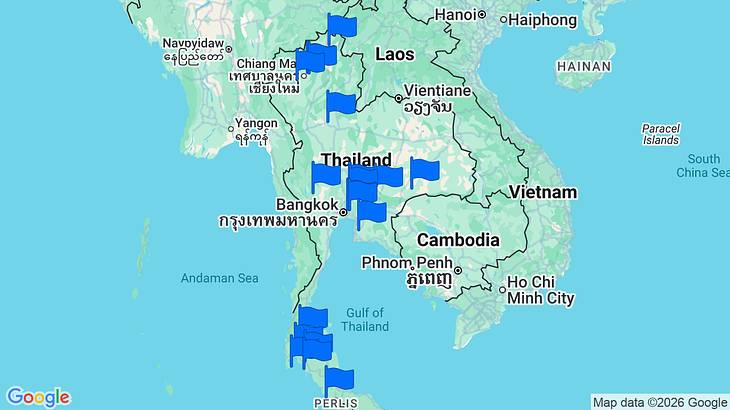
Thailand Landmarks Map
A map of Thailand landmarks. Use the map to explore all of the points of interest.

The Grand Palace
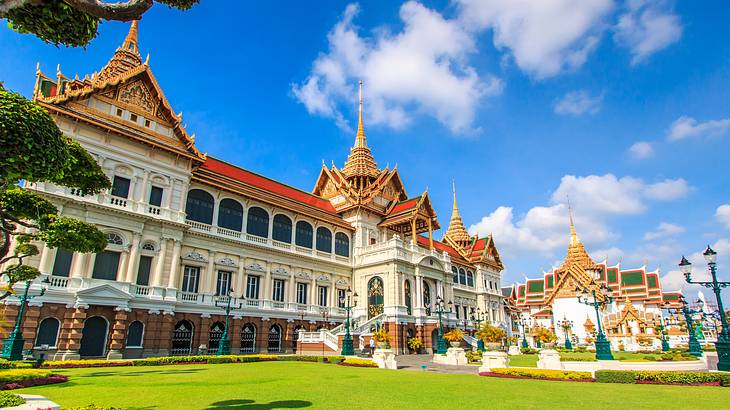
Construction of the Grand Palace began in 1782 when King Rama I moved the capital to Bangkok. The complex is one of the most visited landmarks in Asia and served as the royal residence and seat of government until 1925.
Its grounds cover roughly 218,000 square meters along the Chao Phraya River. The area is divided into the Outer Court, which contains the Temple of the Emerald Buddha, the Middle Court, with its ceremonial throne halls, and the Inner Court, which once housed the royal family.
The architecture blends traditional Thai, Khmer, and European styles across more than 100 structures. Visitors should dress modestly, with shoulders and knees covered, or they will be turned away at the gate.
☂️ Visit The Grand Palace with an experience

Wat Phra Kaew
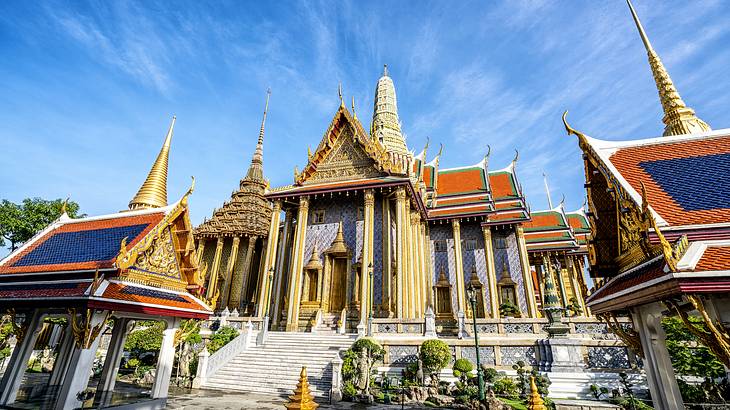
Wat Phra Kaew, also known as the Temple of the Emerald Buddha, is located in the Grand Palace's Outer Court and houses Thailand's most sacred Buddhist image.
The Emerald Buddha, a 66-centimeter figure carved from green stone, entered the historical record in 1434 when lightning cracked open a chedi in Chiang Rai, revealing the statue hidden beneath.
It traveled through Lampang, Chiang Mai, and Vientiane before King Rama I brought it to Bangkok in 1784. The reigning monarch changes the statue's gold garments three times a year to mark the summer, rainy, and winter seasons.
The temple is one of the best places to visit in Bangkok. Photography inside the chapel is not permitted, so take your time observing the interior murals instead.
☂️ Discover The Temple of the Emerald Buddha on a tour
Erawan National Park
Erawan National Park was established in 1975 as Thailand's 12th national park, covering 550 square kilometers of limestone hills in Kanchanaburi Province.
Its centerpiece is Erawan Falls, a seven-tiered waterfall named after the three-headed elephant of Hindu mythology, whose shape at the uppermost tier is said to resemble the creature's head.
The lower tiers have wide, swimmable pools with an emerald-green tint. The trail to the top tier is roughly two kilometers and becomes steep and rocky the higher you go, so sturdy shoes are worth packing.
☂️ Explore Erawan National Park with a tour

Wat Rong Khun
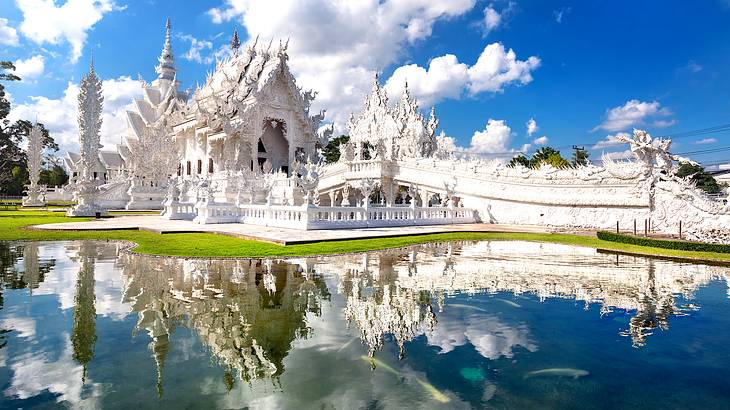
Better known as the White Temple, Wat Rong Khun in Chiang Rai is the creation of Thai artist Chalermchai Kositpipat. He began rebuilding the temple in 1997 on the site of an older, deteriorating structure, funding much of the work by selling his own paintings.
The main assembly hall is finished in white plaster and glass mosaic to symbolize purity in Buddhist teaching. The interior murals mix traditional Buddhist imagery with unexpected modern references.
Chiang Rai is home to several notable temples, and visiting Wat Rong Khun is one of the top things to do in the area. Construction is ongoing, and Chalermchai has said the project may take decades to complete.
☂️ Visit Wat Rong Khun - White Temple with a tour

Wat Mahathat
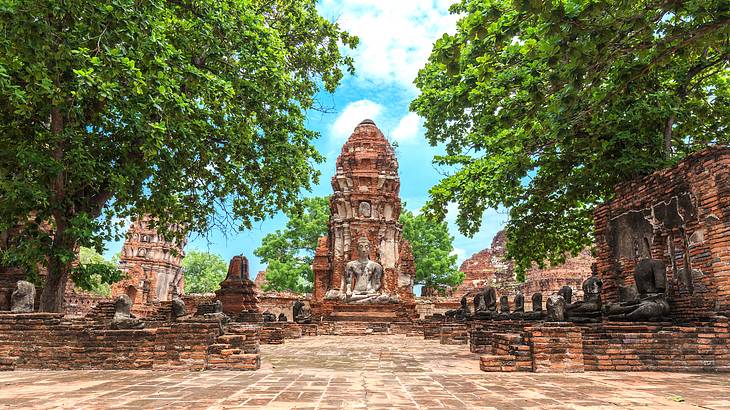
Built in 1374 by King Boromma Rachathirat I in Ayutthaya, Wat Mahathat served as the residence of the Supreme Patriarch and the kingdom's most important royal monastery.
It is one of the most significant temples in Ayutthaya, and the central prang once stood 43 meters tall before it collapsed in the early 17th century and again in the early 20th century. Excavations by the Fine Arts Department in 1956 uncovered relics, gold ornaments, and votive tablets in the prang's crypt.
The temple's most recognizable image is a sandstone Buddha head entwined in the exposed roots of a tree. Visitors photographing it are asked to crouch below the head as a sign of respect.

Big Buddha Phuket
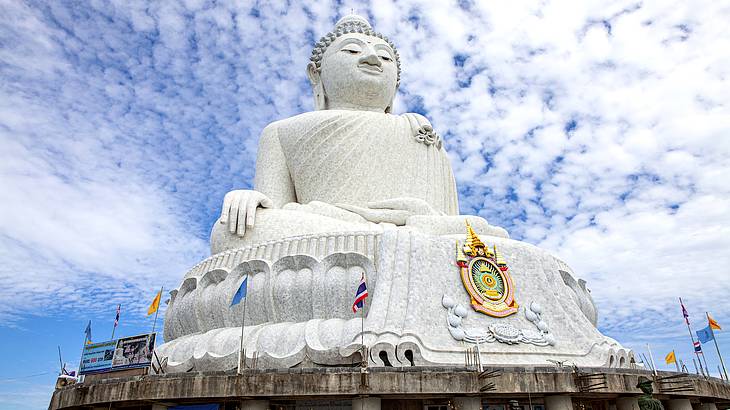
Many consider Phuket a top place to stay in Thailand thanks to its beaches and cultural sites. The most prominent of these is a 45-meter reinforced-concrete Buddha statue atop Nakkerd Hill in the south of the island, clad in white jade marble from Myanmar.
The Supreme Patriarch of Thailand granted it the official name Phra Phutta Ming Mongkol Eknakiri in 2008. The statue depicts the Buddha in the subduing-Mara posture and rests on 50 ferroconcrete piers sunk 12 meters deep.
The hilltop offers wide views over Chalong Bay, Kata, and the surrounding coastline. Construction began in 2004, and work continues on the surrounding grounds. The site is free to enter and open daily.
Lumphini Park
King Vajiravudh (Rama VI) donated this 57-hectare plot of royal land to the public in 1925, making it Bangkok's first public park. Named after Lumbini, the birthplace of the Buddha in Nepal, the park sits in the Pathum Wan district and is another popular option to add to a Bangkok itinerary.
An artificial lake occupies the center, where visitors can rent paddle boats. Walking paths total roughly 2.5 kilometers and fill with joggers before dawn and after sunset. Keep an eye on the shoreline for the park's resident Asian water monitor lizards, which can grow well over a couple of meters long.
☂️ See Lumphini Park on a tour
- Eight Hours Bangkok Customized Private Day Tour Pick up From Hotel (highly sought-after)
- Bangkok Private Highlights Tour With Local Guide (extremely popular)

Khaosan Road
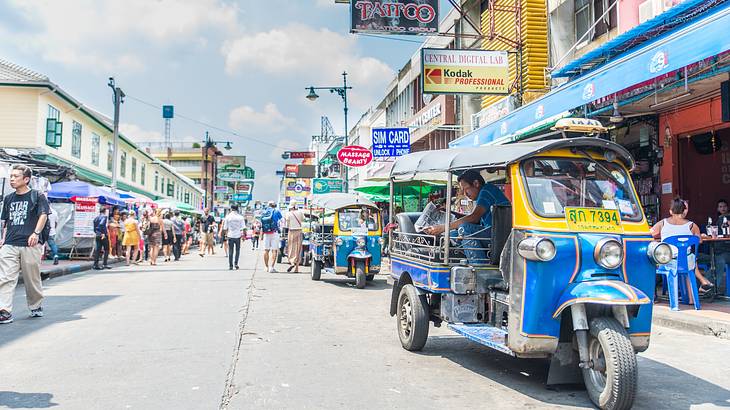
This 410-meter street was built in 1892 during the reign of Rama V. Its name translates to "milled rice," a reference to the rice trade that once dominated the neighborhood.
Since the 1980s, it has evolved into one of Southeast Asia's best-known backpacker hubs, lined with guesthouses, street food vendors, and open-air bars.
Khaosan Road sits about one kilometer north of the Grand Palace, making it a convenient base for exploring Bangkok's historic core. The side streets hold quieter restaurants and traditional shophouses that offer a contrast to the neon-lit main strip.
☂️ Discover Khaosan Road on a tour
- Bangkok Tuk Tuk Tour - Hotel-pickup & Dinner (top-rated tour)
Koh Phi Phi Islands
This group of six islands in Krabi Province forms part of the Hat Noppharat Thara-Mu Ko Phi Phi National Park. Phi Phi Don is the only inhabited island and the base for accommodations.
Phi Phi Leh, the smaller neighbor, is home to Maya Bay, which gained worldwide attention after the 2000 film The Beach. Overtourism forced Maya Bay to close entirely from 2018 to early 2022 to allow the ecosystem to recover.
The archipelago is often included on Southeast Asia itineraries, and Maya Bay has since reopened with visitor limits and a seasonal closure each August and September. Snorkeling, diving, and kayaking are the primary activities across the islands.
☂️ Explore the Phi Phi Islands on a tour
Sukhothai Historical Park
The ruins of Thailand's first major kingdom spread across the plains of northern Thailand, about halfway between Bangkok and Chiang Mai.
Sukhothai served as the capital from the 13th to the 15th century and is considered the birthplace of the Thai alphabet, Thai art styles, and Theravada Buddhism. UNESCO inscribed the Historic Town of Sukhothai and Associated Historic Towns in 1991.
Wat Si Chum, in the park's northern zone, houses a seated Buddha called Phra Achana, which stands roughly 15 meters tall inside a roofless brick mondop.
Renting a bicycle at the central-zone gate is the best way to cover the park's spread-out ruins. The northern and western zones are ticketed separately but are far less crowded.
☂️ Visit Sukhothai Historical Park with an experience
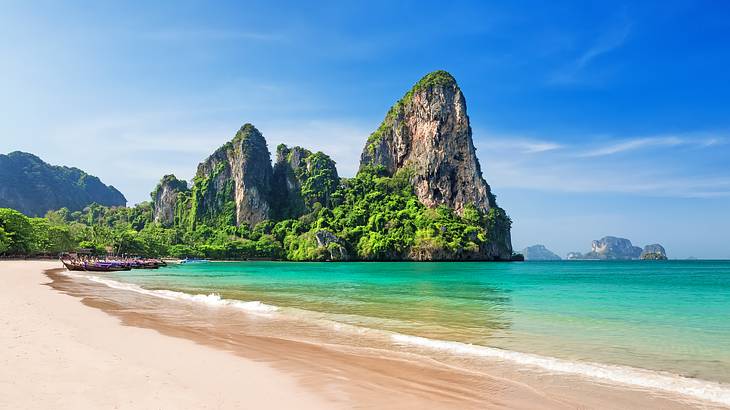

Railay Beach
Tucked between towering limestone cliffs near Krabi, Railay Beach is accessible only by boat because no road cuts through the surrounding rock. The geology that isolates the beach also makes it one of Thailand's top rock-climbing destinations, with several bolted routes on the karst walls.
The area is divided into Railay West, Railay East, and Phra Nang Beach, each with a different character. Long-tail boats run from Ao Nang throughout the day, and the crossing takes about 15 minutes. The caves at the southern end and the viewpoint trail above Phra Nang are worth the detour for anyone not planning to climb.
☂️ Explore Railay Beach on a tour
Wat Phra That Doi Suthep
Perched on the slopes of Doi Suthep mountain at roughly 1,050 meters above sea level, this temple is the most sacred in Chiang Mai. It was founded around 1383 to enshrine a Buddhist relic, and a 306-step naga-flanked staircase leads from the road to the temple.
A cable car is also available for those who prefer to skip the climb. The gilded chedi at the center dominates the terrace, and the surrounding viewpoints offer sweeping panoramas of Chiang Mai city below.
The temple is 15 kilometers from the city center, and songthaew (shared red trucks) run regularly from the Old City. An early morning visit avoids both the heat and the tour-group crowds.
☂️ Explore Wat Phra That Doi Suthep with a tour
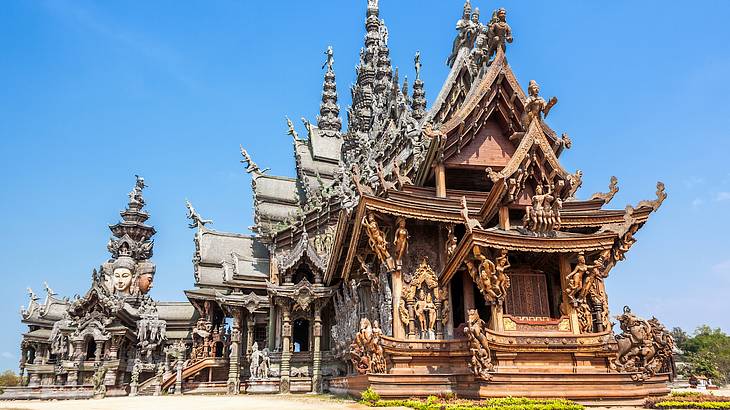

The Sanctuary of Truth Museum
Standing on a headland in Pattaya, the Sanctuary of Truth is an all-wood structure covered in intricate carvings that draw on Buddhist, Hindu, and Chinese philosophical themes.
Construction began in 1981 and is still underway. The building uses traditional wood-joinery techniques. The carvings depict figures and scenes from four artistic traditions: Thai, Khmer, Chinese, and Indian.
The structure reaches roughly 105 meters in height, and its official site describes it as "the largest wooden castle in the world." Visitors can watch artisans carving new panels on site during regular working hours.
☂️ Join a tour to see the Sanctuary of Truth Museum
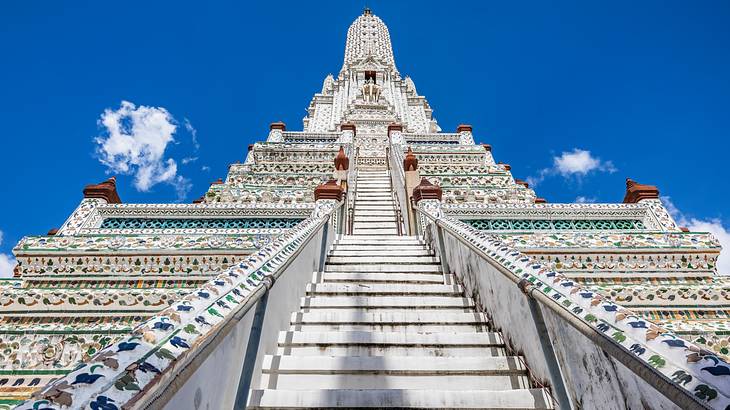

Wat Arun
The central prang of Wat Arun, also known as the Temple of Dawn, rises from the Thonburi bank of the Chao Phraya River, opposite the Grand Palace. The site dates to the Ayutthaya period, when it was known as Wat Makok.
King Taksin renamed it in 1768, and the temple briefly housed the Emerald Buddha before it was taken across the river. The prang visitors see today was built under Rama II and completed under Rama III around 1851.
Its surface is covered with many fragments of Chinese porcelain, arranged in varying patterns. Sunset views from the opposite bank are spectacular, but walking the steep prang stairs at midday reveals the mosaic details up close.
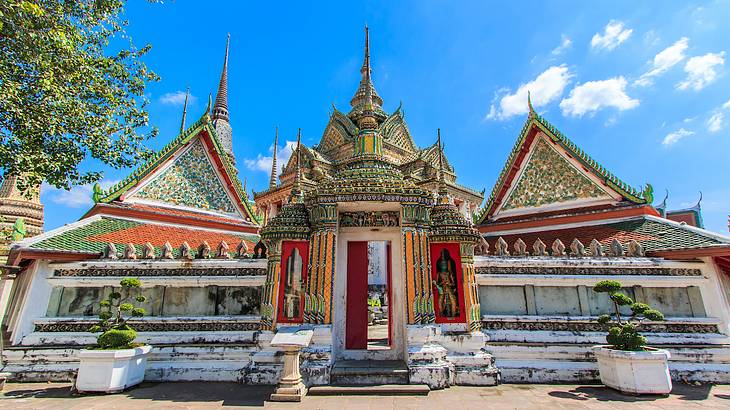

Wat Phra Chetuphon
Known widely as Wat Pho, this is Bangkok's oldest and largest temple complex. A monastery existed here before Bangkok became the capital, and Rama I rebuilt it from 1788.
The Reclining Buddha, added under Rama III and completed in 1848, stretches 46 meters long and 15 meters high. It is made of plaster over a brick core, finished in gold leaf, with mother-of-pearl inlays on the soles of the feet depicting 108 auspicious symbols.
Rama III also turned Wat Pho into Thailand's first public learning center by commissioning more than 1,400 stone inscriptions on medicine, literature, and other subjects. These inscriptions earned a UNESCO Memory of the World designation in 2011.

Khao Sok National Park
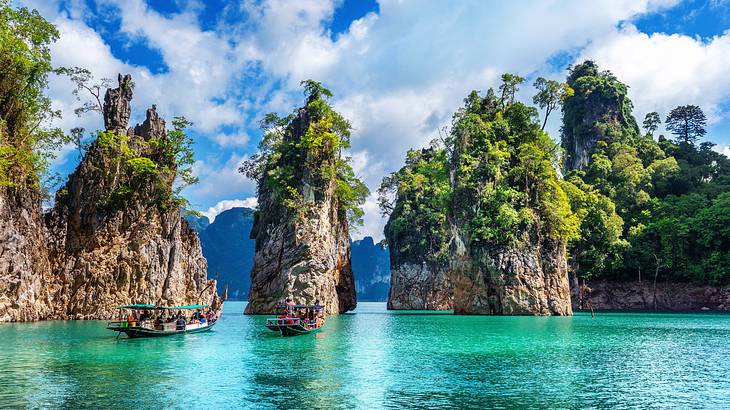
Khao Sok was designated Thailand's 22nd national park in 1980 and covers 739 square kilometers in Surat Thani Province. The park's defining feature is Cheow Lan Lake, a reservoir created by the Ratchaprapha Dam, completed in 1987.
Towering limestone karsts rise from the emerald water, and floating bungalows offer overnight stays on the lake. The surrounding rainforest supports elephants, gibbons, and the Rafflesia kerrii, one of the largest flowers in the world.
Canoeing on the lake and guided jungle treks are the main activities. The park is a convenient stop between the Gulf and Andaman coasts.
☂️ See Khao Sok National Park on a tour

Doi Inthanon National Park
Thailand's highest peak reaches 2,565 meters above sea level in Chiang Mai Province. The mountain was formerly called Doi Luang, meaning "great mountain." The summit temperature averages 10 to 12 degrees Celsius year-round, so bring a jacket even in the Thai summer.
It was renamed to honor King Inthawichayanon, one of the last rulers of Chiang Mai. He asked that his ashes be kept at the summit. A stupa at the peak holds those remains.
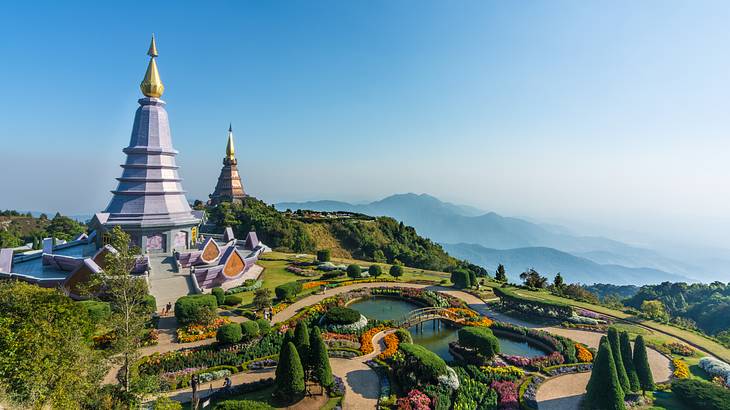
The park covers 482 square kilometers and contains waterfalls, cloud forests, and remote Karen and Hmong villages. Two royal chedis near the summit, dedicated to King Bhumibol Adulyadej and Queen Sirikit, are surrounded by landscaped gardens with broad viewpoints.
☂️ Visit Doi Inthanon National Park with an excursion

Tha Phae Gate
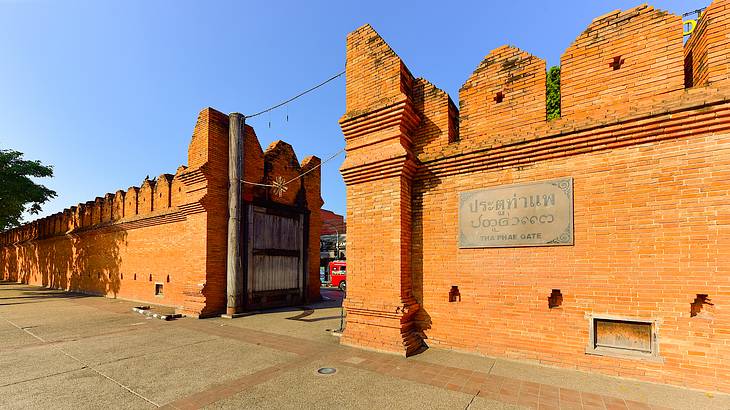
King Mangrai founded Chiang Mai in 1296 and enclosed his new Lanna capital within fortified walls and a moat. Tha Phae Gate served as the main eastern entrance.
The current brick structure is a reconstruction from 1985 to 1986; the original gate was demolished in 1948. Portions of the moat and wall survive on all four sides of the Old City, along with the other gates.
The open square in front of Tha Phae Gate functions as Chiang Mai's informal town square. It can be a natural starting point for anyone building a Chiang Mai itinerary, and on Sunday evenings the area becomes the launching point for the popular Walking Street night market.

Phanom Rung Historical Park
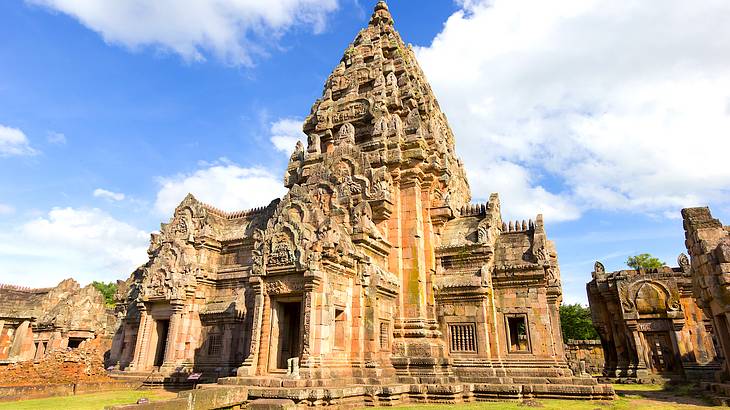
This Khmer Hindu temple sits on the rim of an extinct volcano in Buriram Province, northeastern Thailand. Built of sandstone and laterite between the 10th and 13th centuries, it was dedicated to Shiva and designed to represent Mount Kailash.
Thailand's Department of Fine Arts spent 17 years restoring the complex, and it opened to the public in May 1988. The most famous element is the Phra Narai lintel above the eastern entrance, depicting a reclining Vishnu.
It was stolen in the 1960s and displayed at the Art Institute of Chicago until a public campaign secured its return in 1988. The processional walkway leading up to the sanctuary is one of the finest examples of Khmer architecture outside Cambodia.
Wat Chaiwatthanaram
King Prasat Thong built Wat Chaiwatthanaram in 1630 on the west bank of the Chao Phraya River in Ayutthaya, on the site of his mother's former residence. Her ashes were placed in two chedis beside the ordination hall.
The layout follows the Khmer mountain-temple concept: a 35-meter central prang representing Mount Meru stands at the center, surrounded by eight smaller chedis in a rectangular gallery.
The temple was looted and burned during the 1767 Burmese invasion and sat abandoned for over two centuries. The Fine Arts Department began restoring it in 1987, and it reopened to the public in 1992.

Ao Phang Nga National Park
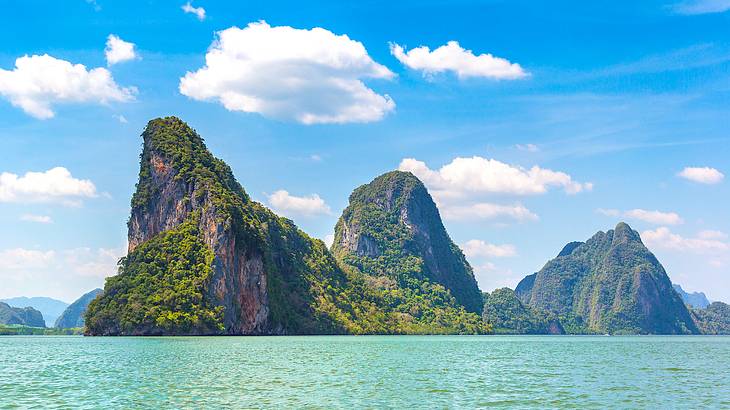
Established in 1981, this marine national park covers 400 square kilometers of the Andaman Sea in Phang Nga Province. More than 40 limestone islands rise sharply from the water, surrounded by mangrove forests and tidal lagoons.
Boat tours are the standard way to explore the park, and kayaking through the sea-level caves into hidden lagoons is one of southern Thailand's most distinctive experiences.
Ko Tapu, a 20-meter-tall needle-shaped rock, became internationally famous after appearing in the 1974 James Bond film The Man with the Golden Gun. Since 1998, tourist boats have been prohibited from approaching Ko Tapu directly.
☂️ Visit Ao Phang Nga National Park with a tour

Tarutao National Park
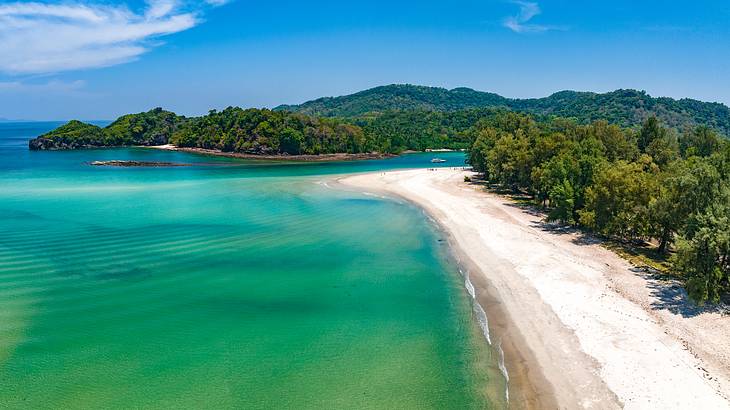
Thailand's second marine national park was established in 1974 and consists of 51 islands off the coast of Satun Province in the Andaman Sea. The park covers 1,490 square kilometers and sits near the Malaysian border, just north of Langkawi.
Tarutao Island served as a penal colony for political prisoners from the late 1930s. During World War II, supply lines from the mainland were cut, and guards and prisoners turned to raiding passing ships to survive. The prison ruins are now part of a historical trail.
The park's beaches remain among the least developed in southern Thailand. Access is seasonal and typically closes during the monsoon months, so check whether it's open before planning a visit.

Bang Pa-In Palace
King Prasat Thong built the original palace on an island in the Chao Phraya River in 1632, near Ayutthaya. It fell into ruin after the Burmese invasion of 1767 and was abandoned for nearly a century until King Mongkut (Rama IV) began restoring it.
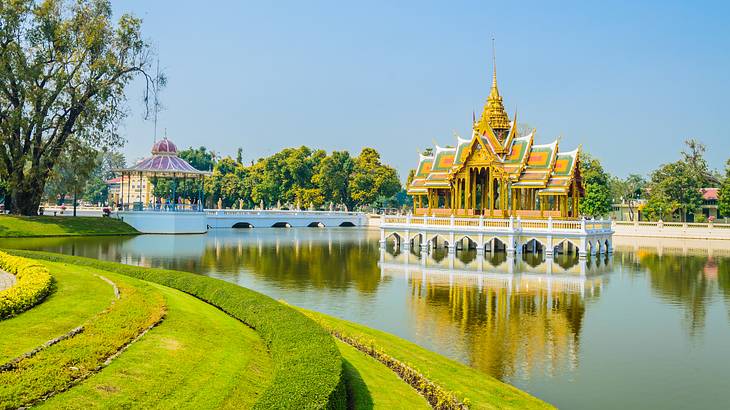
Most of the buildings visitors see today were constructed between 1872 and 1889 by King Chulalongkorn (Rama V). The palace's standout structure is the Aisawan Thiphya-Art, a Thai-style pavilion set in the middle of an ornamental pond. Built in 1876, it houses a bronze statue of King Chulalongkorn.
The surrounding buildings mix Thai, Chinese, and European architectural styles. The grounds include topiary gardens where trees have been clipped into the shapes of elephants and other animals.

Khao Yai National Park
Thailand's first national park was established on 18 September 1962 and covers 2,168 square kilometers. In 2005, it was inscribed as part of the Dong Phayayen-Khao Yai Forest Complex UNESCO World Heritage Site.
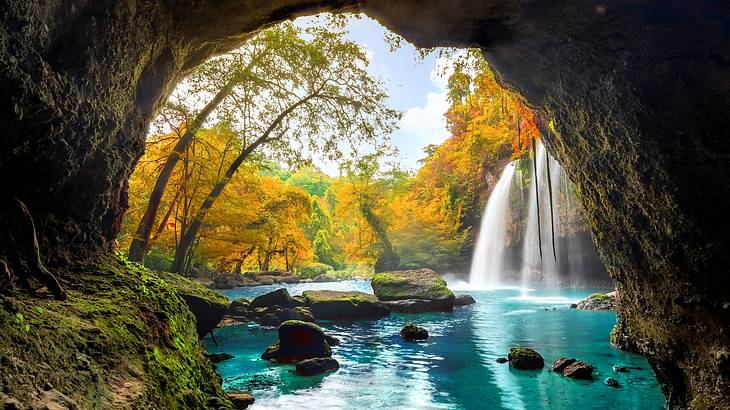
The park's highest point, Khao Rom, reaches 1,351 meters. Haew Suwat and Haew Narok are the park's best-known waterfalls, and the trail network ranges from easy boardwalks to full-day jungle hikes. Wild elephants, gibbons, and hornbills are regularly sighted.
Some trails pass through areas with wild animals, so hiring a guide for longer routes is strongly recommended. The park is a few hours from Bangkok, making it a feasible day trip.
☂️ Discover Khao Yai National Park on a tour
In Conclusion
Thailand's landmarks reflect a layered history that runs from the Khmer-influenced stone temples of the northeast to the gilded chapels of Bangkok and the protected coastlines of the south.
The 24 sites covered here span ancient capitals, living temples, and some of the most distinctive natural landscapes in Southeast Asia. Use this list as a starting point, and adjust your route based on how much time you have and which region draws you the most.

Want to keep exploring?
Subscribe for our latest guides.
Thank you for subscribing
We will be in touch soon with our latest guides.
Want to keep exploring?
Subscribe for our latest guides.
Thank you for subscribing
We will be in touch soon with our latest guides.